
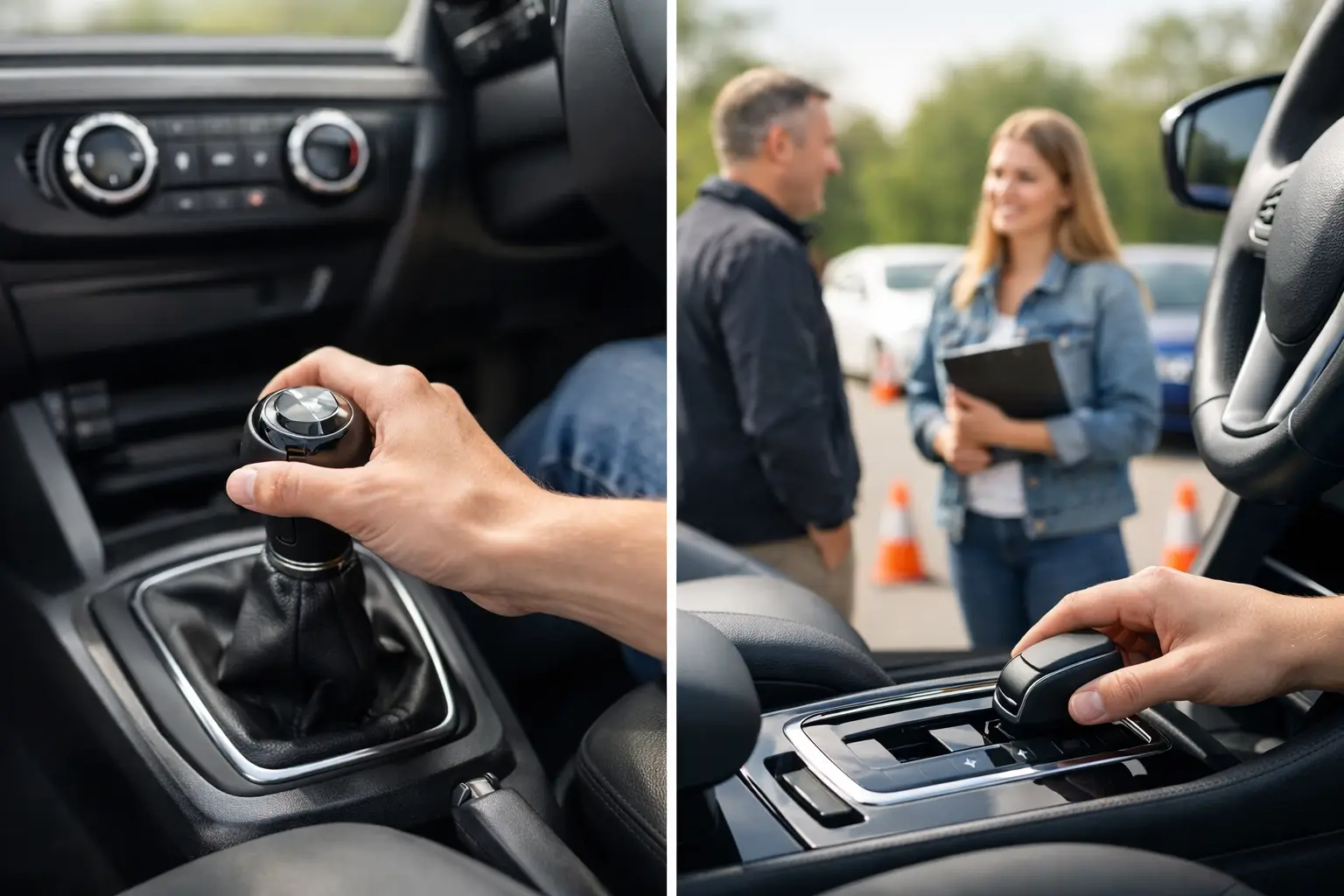
Choosing a gearbox can feel like a small decision until you start comparing manual automatic costs. One car has a clutch and gears to manage; the other does not. But the real question is not simply, “Which lessons are cheaper?” It is which route gives you the confidence, licence options and overall value that fit your life.
For some learners, automatic lessons are the quickest way to feel comfortable in traffic, at busy roundabouts and on Peterborough’s stop-start roads. For others, learning manual feels worth the extra coordination because a manual licence gives them more choice later. Neither option is automatically the right one. A patient instructor should help you weigh up the cost without making the decision feel bigger than it needs to be.
Manual Automatic Costs: Start With Lesson Time
The hourly price of manual and automatic tuition can differ. Automatic cars can cost more to buy, lease, insure and maintain, so some driving schools charge a little more per hour for automatic lessons. That does not mean automatic driving will cost more overall.
Your total lesson cost comes from two things: the lesson rate and the number of hours you need. The second part is often more significant. A learner who struggles with clutch control, moving off smoothly or hill starts may need more time in a manual. In an automatic, they can focus earlier on observations, planning, positioning and safe decision-making because the car handles the gear changes.
That can be a genuine advantage for nervous beginners, busy adults returning to driving, or learners who have had several difficult experiences with a clutch. If automatic tuition helps you make steady progress in fewer lessons, a slightly higher hourly rate may represent better value.
On the other hand, plenty of learners pick up manual control quickly. Once clutch control becomes natural, there may be little practical difference in the number of lessons required. This is why comparing a single lesson price tells only half the story. It is better to look at your likely learning journey, not just the figure beside “one hour”.
Why Learning Time Varies So Much
There is no honest fixed number of lessons that guarantees a pass. Every learner starts in a different place. Someone who has practised regularly with a suitable supervising driver may progress differently from someone learning only during weekly lessons. Confidence, concentration, previous road awareness and how often you practise all matter too.
Manual learners have an extra set of physical skills to develop. They need to find the biting point, coordinate clutch and accelerator, select the appropriate gear and avoid stalling while still checking mirrors and responding to hazards. At first, that can feel like trying to pat your head, rub your stomach and read a road sign at the same time. It does become easier.
Automatic learners still need to become safe, capable drivers. Removing the clutch does not remove the need for good judgement. You still need accurate steering, effective observation, appropriate speed, lane discipline, parking skills and calm responses to the unexpected. The learning focus simply shifts sooner towards the road rather than the mechanics of changing gear.
A tailored lesson plan matters here. Rather than booking lessons blindly and hoping for the best, ask for clear feedback on what you can already do, what needs work and what would make practice more useful between sessions. Measurable progress keeps both confidence and spending on track.
Test Fees Are Usually the Same
The theory test fee is the same whether you intend to take a manual or automatic practical test. The standard weekday practical driving test fee is also the same for both transmission types. You may pay more if you choose a weekend, evening or bank holiday appointment where those are available, but that is not a manual-versus-automatic difference.
What can change is the cost around the test. Most learners use their instructor’s car, which usually means paying for a lesson beforehand and the use of the car during the test. This is sensible: you arrive warmed up in a vehicle you know, rather than meeting the examiner after a stressful drive in an unfamiliar car.
If you need to retake a test, the extra cost is naturally more than the test fee alone. There may be further lessons, another car-use charge and a delay while waiting for a new appointment. That is why rushing to test before you are consistently ready can become false economy. A good instructor will be encouraging, but honest enough to say when a few more focused sessions could protect your chances.
The Licence Difference Can Affect Long-Term Value
This is the key distinction many learners miss when comparing manual automatic costs. Passing in a manual car gives you a full licence that allows you to drive both manual and automatic vehicles. Passing in an automatic gives you an automatic-only licence.
For some people, that restriction is irrelevant. If your household drives automatics, you plan to buy an automatic, or you are likely to drive an electric vehicle, an automatic licence may suit you perfectly well. Most electric cars do not have a conventional manual gearbox, and automatic vehicles are increasingly common.
For others, manual entitlement is useful flexibility. You may want to share a family car, borrow a friend’s vehicle, choose from a wider range of lower-priced used cars, or take a job that requires driving a manual vehicle. There is no point paying for a manual licence purely because someone says you “should”, but it is worth considering the next few years rather than only the test date.
If you pass automatic and later decide you need manual entitlement, you will need to pass another practical test in a manual car. That means more tuition and another test fee. Conversely, forcing yourself through manual lessons when the clutch is causing real anxiety can also cost more, both financially and emotionally. Freedom is the goal, not collecting the most complicated route to it.
Car Ownership Costs Need a Reality Check
People often assume manuals are always cheaper to buy and insure. Historically, that was often true, particularly among older used cars. The picture is now less tidy. Prices depend on the make, model, age, engine type, local demand, condition and insurance group. An automatic version of the same car may cost more, but not always by enough to make the decision for you.
Insurance for new drivers is affected far more by your age, postcode, annual mileage, occupation, claims history and the specific vehicle than by transmission alone. A small automatic in a sensible insurance group may be more affordable to insure than a powerful manual hatchback. Compare quotes for actual cars before treating gearbox type as the deciding cost.
Maintenance is also mixed. A manual clutch can wear out and be expensive to replace. Automatic gearboxes can be complex and costly if neglected. The condition and service history of the vehicle matter more than broad assumptions. If you are buying used, an independent inspection can be money well spent.
How to Make a Sensible Choice
Start with the type of driving you expect to do. If your goal is commuting locally, school runs, city traffic or gaining independence as soon as possible, automatic may be a very practical fit. If you expect to need maximum vehicle choice, want to drive a family manual car, or simply enjoy learning the full process of gear control, manual could be the stronger long-term choice.
Then consider how you learn. A calm beginner who enjoys a challenge may flourish in a manual. A learner who becomes overloaded when traffic builds may make faster, safer progress in an automatic. There is no prize for stalling at every set of lights, and there is no shortcut in becoming a responsible automatic driver either.
Before booking a block of lessons, ask what is included, how progress will be reviewed and whether your instructor can adapt the plan if your needs change. At D4Driving School of Motoring, the aim is not to push every learner towards one gearbox. It is to build your skills with clear, patient instruction in the car that gives you the best chance to drive confidently and safely.
The best value is not always the lowest hourly price. It is the tuition that helps you become test-ready without wasted lessons, leaves you confident behind the wheel, and gives you a licence that suits the roads and opportunities ahead of you.