
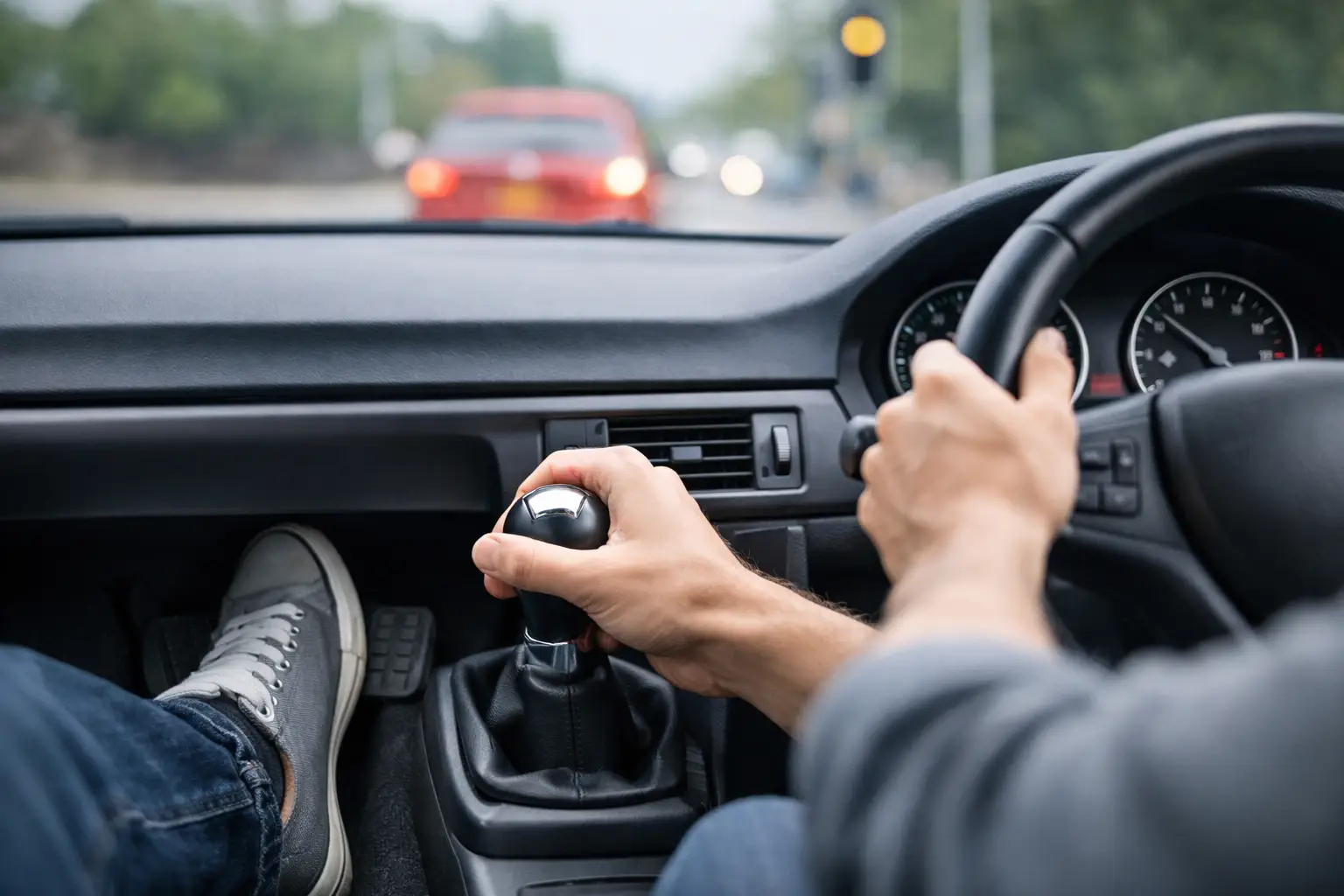
That moment when the car shudders, stalls, and the queue behind you suddenly feels very interested in your life choices - yes, that’s usually where people start searching for how to overcome clutch control. The good news is that clutch control is not some mysterious talent other people are born with. It is a physical skill, and like any skill, it gets easier when you understand what the car is doing and practise it the right way.
If you are struggling, you are not failing. You are learning timing, pressure, sound, and feel all at once. That is quite a lot for one left foot.
Why clutch control feels so difficult at first
Clutch control can feel awkward because it asks you to do something very precise without giving you much room for panic. You are balancing the engine, the clutch plate, the brake, and sometimes the accelerator too. For new drivers, it often feels like there is a tiny magic spot you are supposed to find instantly.
In reality, the biting point is not magic. It is simply the point where the clutch starts to connect the engine to the wheels. Lift too quickly and the engine struggles, then stalls. Hold it too high for too long and the car can crawl, but the control feels shaky. Add a hill, traffic, or nerves, and suddenly your feet forget they’ve ever met a pedal before.
That is why patient, repeated practice matters. You are training your body to recognise what the car feels and sounds like when it is ready to move.
How to overcome clutch control by understanding the bite
The fastest way to improve is to stop thinking of the clutch as an on-off switch. It is a gradual connection. The biting point is where the car begins to want to move, and your job is to notice that moment early.
You will usually feel one or more of these signs. The engine note changes slightly. The front of the car may lift a touch. The car may strain forward gently. On a hill, the bonnet may settle as the car prepares to move. Those little signals are your best friends.
Many learners make the same mistake - they try to get past the biting point as quickly as possible because they are afraid of stalling. Ironically, that rush often causes the stall. The better approach is calm and measured. Bring the clutch up slowly until you find the bite, pause briefly to let the car respond, then continue smoothly.
There is no prize for the fastest left foot.
Start with your feet, not your fear
If you are tense, your feet become jerky. That is one reason clutch control often goes wrong in busy traffic or at roundabouts. The pressure behind you feels bigger than it is, and you end up rushing the exact part that needs to be gentle.
Try setting yourself a simple routine. Left foot down fully. Select first gear. Set the gas if needed. Release the handbrake when ready. Raise the clutch slowly to the bite. Hold. Let the car move. Then continue lifting smoothly. A routine gives your brain something solid to follow when nerves try to take over.
It also helps to keep your heel grounded where possible. That gives you more control and stops your foot springing up too fast. Small, controlled movement is what you want. Not a dramatic pedal launch worthy of a West End performance.
When to use gas and when not to
This depends on the car and the situation. On flat ground, many modern cars can move off with clutch control alone, especially in a calm practice setting. On hills, in slower older cars, or when you need a more positive move-off, a little gas helps support the engine.
The key phrase here is a little. Too much gas with an unsteady clutch can make the car surge. Too little and the engine may struggle. That balance improves with practice, but it is easier when you stop aiming for perfection on every move-off. Aim for controlled and safe first. Smoothness comes next.
The best way to practise clutch control
Quiet roads and empty car parks are useful at the start because they remove pressure. You can repeat the same move-off again and again until your foot starts to remember it. Repetition matters more than complexity in the early stages.
A good practice session focuses on one thing at a time. Spend ten minutes just finding the biting point and holding it. Then practise moving off and stopping. Then try the same exercise with a little gas. Then repeat on a gentle incline. Building in layers is far more effective than throwing yourself into town-centre traffic and hoping your clutch suddenly becomes cooperative.
If you are learning with an instructor, ask for a lesson section devoted just to clutch control. One-to-one tuition is especially useful here because the teaching can be adjusted to how you learn. Some learners need a technical explanation. Others improve faster when they work by feel and repetition.
Hill starts need their own practice
A lot of learners think they are bad at clutch control when actually they are mostly struggling with hill starts. That is a different challenge. On a hill, the car needs more support before it moves, so your timing between clutch, gas, and handbrake matters more.
The trick is not speed. It is preparation. Set the gas first, raise the clutch to the bite, feel the car hold itself, then release the handbrake and move away. If you release the handbrake too early, the car may roll. If you lift the clutch too fast, it may stall. When practised properly, hill starts become a routine rather than a drama.
Common mistakes that keep clutch problems going
One common issue is lifting the clutch in one motion instead of two. The first part gets you to the biting point. The second part takes you beyond it once the car is moving. Breaking it into stages makes the whole process much calmer.
Another mistake is staring only at the pedals in your mind and forgetting observation. Good clutch control is part of the full move-off routine, not a separate event. You still need to check mirrors, assess the road, and move only when safe. That is why structured lessons matter - they help you build the full habit, not just the left-foot part.
Some learners also become overly dependent on one exact car. Then they panic when another car feels different. It is true that every clutch has its own personality. Some are higher, some bite sooner, some feel forgiving, and some seem to hold grudges. But the principles stay the same. If you understand the bite and move your foot with control, you can adapt.
How to overcome clutch control when nerves are the real problem
Sometimes the mechanical side is not the biggest issue. Anxiety is. A learner can understand the steps perfectly while parked, then forget them the moment another car appears behind them.
If that sounds familiar, make your goal smaller. Instead of telling yourself, “I must not stall,” aim for “I will set the car up properly.” A stall is not ideal, but it is manageable. Panicking about the possibility of a stall usually makes it more likely.
Give yourself permission to reset. If the move-off does not feel right, clutch down, brake, breathe, and start again. That is better than forcing a poor attempt. Calm drivers are not people who never make mistakes. They are people who recover without turning one mistake into three.
For many learners in places like Peterborough, where you may meet everything from quiet residential roads to busier junctions, building confidence gradually makes a real difference. You do not need every lesson to feel perfect. You need it to feel productive.
Progress is often slower, then suddenly obvious
Clutch control rarely improves in a straight line. One day you move off brilliantly five times, then stall twice and wonder if you have gone backwards. You have not. Learning often looks messy before it starts to feel automatic.
What matters is whether you understand why the stall happened. Did you raise the clutch too quickly? Skip the gas on a hill? Rush because someone was waiting? Once you can spot the reason, you can fix it.
That is the point where confidence starts to become real. Not because everything is perfect, but because problems stop feeling random.
At D4Driving School of Motoring, this is exactly why patient, personalised manual lessons matter. The right support helps you practise the awkward bits without feeling judged, and that is often when the breakthrough happens.
Clutch control is not a pass or fail talent. It is a learnable skill that gets easier when you slow it down, understand the biting point, and let repetition do its job. So if your left foot still feels a bit dramatic at the moment, keep going. With the right practice, it will settle down - and eventually it will wonder what all the fuss was about.