
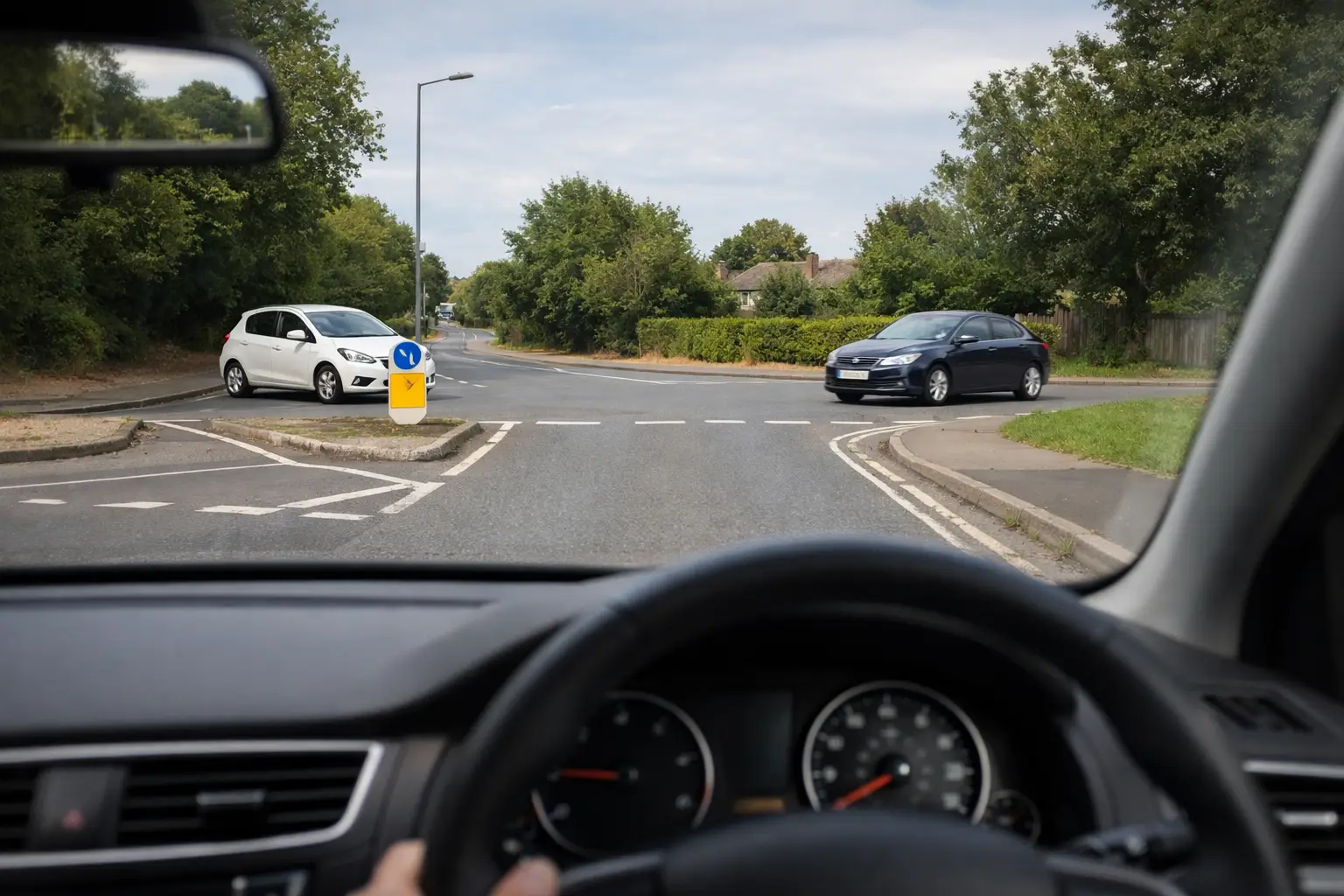
A gap can look generous when you are waiting at a junction, then disappear surprisingly quickly as a car approaches. Learning how to judge junction gaps is not about being brave or guessing well. It is about building a repeatable routine that helps you make safe, confident decisions - whether you are pulling out in Peterborough traffic, turning right at a crossroads or approaching an unfamiliar roundabout on test day.
The good news is that this is a skill, not a personality trait. Nervous learners often think confident drivers simply have quicker reactions. In reality, experienced drivers read speed, distance, road conditions and the behaviour of other road users before they move. With patient practice, you will too.
What makes a junction gap safe?
A safe gap is enough time and space to complete your manoeuvre without causing another road user to slow down, change direction or take evasive action. That sounds simple, but it is why judging gaps needs more than looking for an empty patch of road.
When emerging from a side road, you need time to move from a standstill, steer into position and accelerate to a suitable speed for the road. If you are turning right across traffic, you also need to consider how long it will take to cross the first lane and join the second safely. A gap that works for turning left may be far too small for turning right.
Your own vehicle control matters as well. A learner in a manual car may need a little extra time to find the biting point and move away smoothly. An automatic can remove clutch control from the equation, but it does not remove the need for careful observation and good judgement. The right gap is the gap that works safely for you, your vehicle and the conditions at that moment.
How to judge junction gaps: look, assess, decide
At the give-way line, use a calm sequence rather than repeatedly glancing around and hoping a perfect opening appears. Start with effective observation. Look right, left and right again when emerging onto a road in the UK, while continuing to scan for pedestrians, cyclists and anything that could alter the situation.
Then assess the approaching traffic. Ask yourself two useful questions: how far away is it, and how quickly is it closing that distance? Cars travelling at 30 mph cover ground much faster than they appear to from a stationary position. A vehicle on a 40 mph or national speed limit road needs an even larger gap, even if it is still some distance away.
Finally, make a clear decision. If the gap is safe, commit to the manoeuvre with positive but controlled acceleration. If it is not safe, wait. Half-moving forwards, stopping and then trying again can confuse other drivers and leaves you with less time to observe properly.
A useful mindset is this: do not pull out because you feel pressured by the vehicle behind. They cannot see exactly what you can see, and they are not responsible for your decision. The person behind may be impatient; that is their problem, not your signal to take a risk.
Read speed, not just distance
Distance alone can be misleading. A car that looks far away on a long, straight road may be approaching quickly, while a slower vehicle may be close enough to be safe if you have plenty of room to join the traffic flow.
Look for clues. Is the vehicle getting larger rapidly in your view? Can you hear its engine becoming noticeably louder? Is it travelling downhill, where speed can build? Are there parked cars, bends or road markings that make it difficult to see its approach clearly? These details help you avoid treating every visible vehicle as though it is travelling at the same speed.
Do not rely on indicators as permission to emerge. An approaching car may be indicating left but could have forgotten to cancel its signal, may turn later than expected, or may be signalling for another entrance. Wait until you can see that the driver is genuinely slowing and committing to the turn before using that information as part of your decision.
Give yourself time to move away
Many learners judge a gap from the moment they decide to go, rather than from the moment the car actually moves. That difference matters. Before you commit, be ready: select the correct gear, prepare your feet, set the steering position and know where you are going.
In a manual car, avoid waiting with the clutch at the biting point for too long. It can make the car creep, reduce your focus and wear the clutch. Instead, be prepared, observe properly, then bring the clutch up smoothly and move when the gap is there.
If you stall, stay calm. Secure the car, restart and reassess. Do not rush into the next gap to make up for the stall. A few extra seconds are always better than forcing another driver to brake.
Junctions are not all judged the same way
The shape and purpose of the junction changes the gap you need. A quiet residential T-junction may give you a clear view and low approach speeds. A busy main road with a bend, multiple lanes or a bus stop needs greater caution.
At a crossroads, look beyond the traffic directly in front of you. A vehicle opposite may be turning across your path, a cyclist may be filtering near the kerb, or another road user may be hidden behind a larger vehicle. Never assume that one clear lane means the whole route is clear.
At roundabouts, the decision is often about timing rather than waiting for a completely empty circle. You must give way to traffic approaching from your right that is already on the roundabout, but you should also read its position, speed and likely exit. Again, signals can help, but the vehicle's actual movement is the stronger clue.
When turning right from a major road into a side road, avoid holding up following traffic unnecessarily, but do not let pressure rush you. Position correctly, signal in good time and wait for a safe opportunity. If there is no protected turning lane, you may need to wait patiently for a suitable break in oncoming traffic.
The hazards learners can miss
The road is rarely as simple as two cars and a gap. Before emerging or turning, keep checking for people and hazards that can change the decision.
Pedestrians may step into the road near a junction, particularly where shops, schools or bus stops are nearby. Cyclists and motorcyclists can be difficult to spot and may approach faster than expected. A large van can hide another vehicle behind it, and wet roads mean drivers may need more stopping distance. In darkness, judging speed and distance becomes harder because headlights can make a vehicle seem farther away than it is.
Poor visibility should always make your gap bigger. If parked cars, hedges, rain, glare or a bend limit your view, edge forward only when it is safe and necessary to improve your observation. Keep your speed very low and be ready to stop. You are not claiming priority by creeping out; you are gathering a better view.
What your driving examiner wants to see
During a driving test, you will not be marked down for waiting for a safe gap. Examiners understand that traffic conditions vary. What they need to see is good observation, sound judgement and safe progress when an opportunity is available.
Waiting when it is clearly safe to go can become hesitation, particularly if it holds up traffic repeatedly. But taking a gap that makes another driver brake, swerve or react is much more serious. The aim is not to be the fastest driver at the junction. It is to be a safe, decisive and considerate one.
Keep your observations obvious through your actions: approach at a controlled speed, use the correct position, look properly and move positively once you have decided. You do not need exaggerated head movements, but you do need to show that you are actively checking the road, not staring straight ahead and hoping for the best.
Practise the judgement, not just the manoeuvre
The best way to improve is to repeat junction work in different conditions. Begin on quieter roads, where you can focus on observation and moving away smoothly. Then progress to busier routes, wider junctions, turning right across traffic and roundabouts.
After each attempt, reflect briefly. Did the approaching vehicle reach you sooner or later than expected? Did you feel ready to move when the safe gap came? Were you affected by pressure from behind? These small conversations during a lesson turn a vague feeling of "I never know when to go" into a clear skill you can improve.
At D4Driving School of Motoring, junction practice can be built around your current confidence level, whether you need to slow things down at first or sharpen your decisions ahead of a test. You will not be thrown into the busiest junction in town for dramatic effect - this is a driving lesson, not a reality programme.
The next time you wait at a junction, give yourself permission to pause, observe and choose safety over pressure. Every well-judged gap is another step towards driving with the calm confidence that makes freedom on the road feel properly earned.