
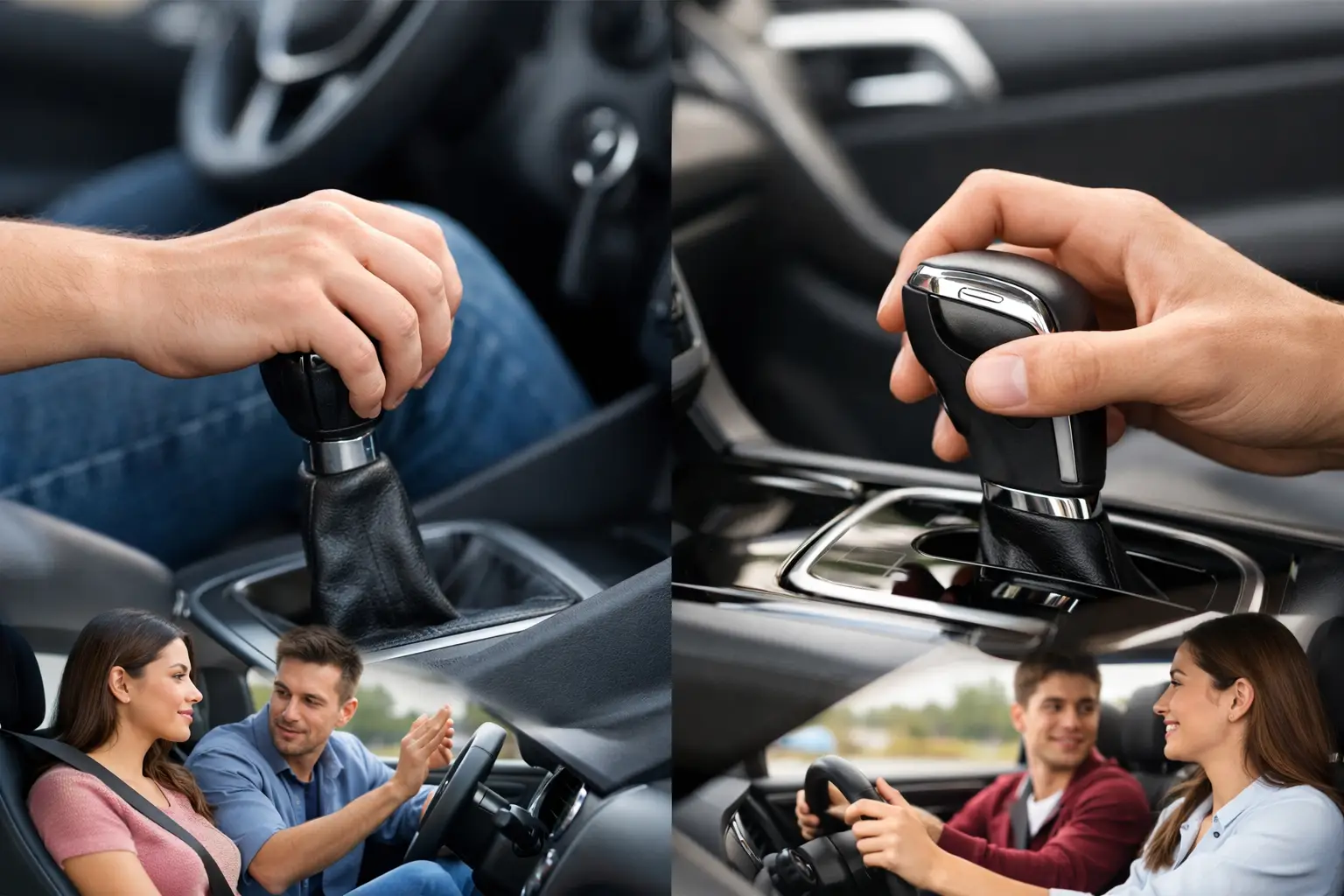
If you are staring at a booking page wondering whether to choose manual or automatic, you are not overthinking it - you are making one of the first real decisions in your driving journey. The choice between manual vs automatic driving lessons for beginners can shape how quickly you build confidence, how much you spend on lessons, and what sort of licence you hold at the end.
There is no gold-star answer that suits everyone. Some learners thrive with the extra control of a manual car. Others make faster, calmer progress in an automatic and never look back. The best choice is usually the one that fits your nerves, your goals and how you learn.
Manual vs automatic driving lessons for beginners: what is the real difference?
On paper, the difference looks simple. In a manual car, you learn clutch control, gear changes and how to coordinate your hands and feet while moving off, slowing down and stopping. In an automatic, the car changes gear for you, so there is less to think about straight away.
In real life, that difference can feel huge in the first few lessons. A complete beginner in a manual is often learning several things at once - steering, mirrors, road position, observation, speed control, clutch biting point and not stalling at the lights while a queue forms behind them. It is a lot. Perfectly normal, but still a lot.
An automatic removes part of that early workload. That often means learners can focus sooner on planning ahead, spotting hazards and reading the road properly. If you are already nervous, that can be a big advantage.
That does not mean automatic is the easy option and manual is the brave one. It simply means the learning experience is different.
Why some beginners do better in a manual
Manual lessons suit learners who want maximum flexibility once they pass. If you pass your test in a manual, you can drive both manual and automatic cars. For many people, that wider choice matters. It can make buying or borrowing a car easier, especially if family members drive manual and you may want to use their car after passing.
There is also something satisfying about learning proper clutch control and gear timing. Once it clicks, many learners feel more involved and more in control of the car. That confidence can grow quickly after the early awkward phase.
Manual can also be the right choice if you are not in a rush and do not mind a slightly steeper learning curve at the start. Some beginners actually enjoy the challenge. They like understanding how the car behaves, and they feel proud when hill starts stop being terrifying and start feeling routine.
The trade-off is that the first stage can be slower. If you are prone to overthinking, adding gears and clutch control may make lessons feel more intense than they need to.
The usual sticking points with manual lessons
Most beginners worry about stalling, rolling back on hills and getting flustered at roundabouts. Fair enough. Those are common hurdles. The good news is that they are teachable skills, not signs that you are a bad driver.
With patient, one-to-one instruction, the usual pattern is simple: what feels clumsy in lesson two starts to feel manageable by lesson six, and much more natural after that. The key is structured practice, not perfection.
When automatic driving lessons make more sense
Automatic lessons are often a strong fit for nervous beginners, adult learners returning to driving, and anyone who wants to reduce pressure in the early stages. If your goal is to become a safe, confident driver without adding mechanical complexity, automatic can be a smart choice.
Because there is less to manage inside the car, many learners settle faster. They can give more attention to junctions, lane discipline, speed awareness and decision-making. Those are the skills that keep you safe for life, not just for test day.
Automatic can also suit learners with busy schedules. If you need to make steady progress in fewer lessons, reducing the number of moving parts can help. It is not magic, and you still need to learn properly, but many people find they become test-ready sooner.
The downside is the licence restriction. If you pass in an automatic, you can only drive automatic vehicles unless you later take another test in a manual. For some learners, that is no issue at all. For others, it is worth thinking about before you book.
Cost, lesson time and the bigger picture
A lot of beginners assume manual is always cheaper and automatic is always more expensive. It is not quite that neat.
Sometimes automatic lessons cost a little more per hour. That can happen. But if a learner needs fewer lessons overall because they feel calmer and progress faster, the total spend may not be wildly different. On the other hand, if you pass in manual, you may have more vehicle options later, which can matter financially too.
This is why it helps to think beyond the hourly rate. Ask yourself which option is more likely to keep you consistent, motivated and improving. The cheapest lesson is not much of a bargain if it leaves you dreading every session.
At D4Driving School of Motoring, lessons are offered in clear time blocks, which helps beginners choose a pace that suits them rather than forcing everything into a one-size-fits-all plan. That matters, because some learners do best with shorter sessions at first, while others gain more from longer lessons where they can settle in and build rhythm.
Manual vs automatic driving lessons for beginners who feel anxious
If your confidence is fragile, be honest about that from the start. Plenty of excellent drivers began as nervous learners. The issue is not whether you feel anxious - it is whether your lessons are built in a way that helps you move through it.
For many anxious beginners, automatic provides a gentler start. Fewer tasks at once can mean fewer panic moments. That breathing space often leads to better concentration and a stronger sense of control.
But some anxious learners actually prefer manual once they try it, because they like having a clear sequence of actions to follow. It gives them structure. That is why a blanket answer rarely works.
A good instructor will look at how you respond in the car, not just what you said before lesson one. If something is not clicking, the lesson plan should adapt. Progress is not about pushing harder. It is about teaching the right thing at the right moment.
Think about your life after the test
It is easy to focus only on passing, especially when the test feels like the giant thing looming ahead. But your decision should also match the sort of driving you expect to do afterwards.
If you expect to borrow a family car and it is manual, learning manual may save hassle later. If you are planning to buy a small automatic for commuting and city driving, automatic may fit your real life perfectly.
If you mostly care about getting mobile, driving independently and building confidence on local roads, there is no shame in choosing the route that gets you there in the calmest, safest way. The best licence is the one that leads to real driving, not one that sits in your wallet while your confidence disappears.
How to decide without tying yourself in knots
Start with three questions. First, how nervous are you about the practical side of driving? Second, do you need the flexibility of a manual licence? Third, are you aiming for the quickest confident route to passing, or are you happy to take on a slightly steeper challenge for broader options later?
If you are calm under pressure, want full licence flexibility and do not mind a more demanding start, manual is often worth it. If you are anxious, short on time, or want to focus on road awareness before anything else, automatic may be the better fit.
If you are still unsure, that is normal. Beginners often do not know what will suit them until they sit in the driver’s seat. The important thing is choosing an instructor who teaches around you - your pace, your weak spots and your goals - rather than treating every learner the same.
Driving is not a race, and your first few lessons do not need to be polished. They need to be safe, well guided and built around steady wins. Choose the option that gives you the best chance of showing up, sticking with it and growing into a confident driver - because that is what freedom on the road really starts with.