
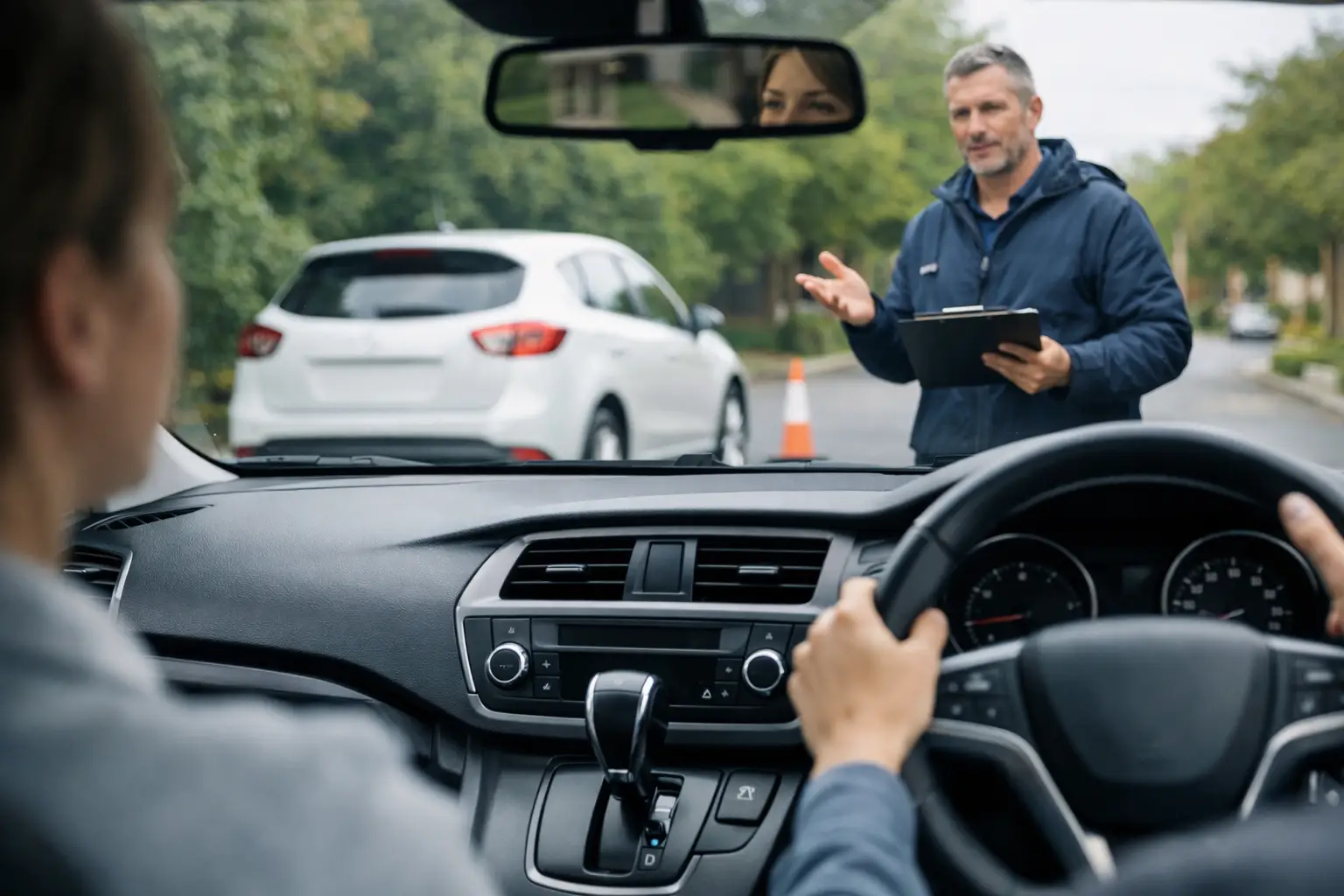
Choosing how to learn is one of the first proper driving decisions you will make. Automatic lessons remove the clutch and gear changes, which can make those early drives feel less like patting your head while rubbing your stomach and more like learning to read the road. For many learners, that extra headspace is exactly what helps confidence begin to grow.
That does not mean automatic is an easy option or a shortcut around safe driving. You still need to develop observation, judgement, road positioning and calm decision-making. The difference is that you can focus on those skills sooner, with patient guidance and a lesson plan that suits where you are now.
What happens in automatic lessons?
An automatic car has two pedals: accelerator and brake. There is no clutch pedal, and the car selects its own gears as you build speed and slow down. Your attention is not split between finding the biting point, changing gear and checking what is happening at a busy roundabout.
In your first lessons, you will still cover the foundations carefully. That includes setting up your seat and mirrors, moving off safely, steering accurately, stopping under control and using effective observations. The car may do the gear changes, but you are always in charge of the drive.
As your confidence builds, your lessons should move at a pace that is right for you. One learner may need more time becoming comfortable in quieter streets. Another may already have experience and need focused work on roundabouts, meeting traffic or parking. Good tuition is not about ticking boxes at top speed. It is about making sure each skill sticks before the next challenge is added.
Why learners choose automatic driving lessons
For some people, automatic simply feels more natural. This can be especially true if you are nervous, returning to driving after a long break, or juggling work, family and a busy diary. Fewer mechanical tasks can make it easier to stay composed when traffic gets complicated.
Automatic lessons can also help learners who find co-ordination difficult at first. Stalling at a junction is a very common part of learning in a manual car, but it can knock confidence when you are already worried about holding up traffic. In an automatic, you can concentrate on planning the junction, choosing a safe gap and steering into the new road.
They are often a sensible choice for learners who know they are likely to drive an automatic after passing. With more automatic and electric vehicles on the road, this is no longer an unusual decision. The best choice is the one that supports your goals, not the one your mate says you ought to make.
There is a practical side too. Automatic cars can be particularly comfortable in stop-start traffic, where a manual driver would be working the clutch repeatedly. If much of your future driving will involve local journeys, commuting or school runs, that may matter to you.
The licence difference: what you need to know
If you pass your practical test in an automatic car, your full licence will allow you to drive automatic vehicles. It will not allow you to drive a manual car.
That restriction is worth thinking about before you book, but it should not automatically put you off. Ask yourself what car you realistically expect to use after passing. If there is a family manual car available, or you want the widest possible choice of second-hand cars, learning manual may offer more flexibility. If your likely car is automatic, or you value a calmer learning process, automatic could be the better fit.
You can change your mind later. A driver with an automatic licence can take further lessons in a manual vehicle and pass another practical test to gain manual entitlement. It is not a one-way door. Still, it is helpful to make the first decision with your everyday driving plans in mind, rather than choosing under pressure.
Automatic does not mean less to learn
A common misconception is that automatic learners do less work. The gearbox handles one part of the driving task, but the standard for safe driving remains exactly where it should be: high.
You will need to show that you can check mirrors at the right time, respond to hazards, use appropriate speed, read signs and road markings, and make safe decisions independently. You will practise manoeuvres, such as parking and pulling up on the right, until they feel controlled rather than lucky. You will also learn to deal with the situations that make many learners tense: busy roundabouts, narrow roads, dual carriageways and awkward meeting points.
Your driving test examiner is not looking for flashy driving. They are looking for safe, consistent choices. A good instructor helps you understand the reason behind each routine, so you can adapt when a familiar road becomes unfamiliar, or when another driver does something surprising.
Building confidence without rushing it
Confidence is not pretending that nothing worries you. It is knowing what to do when something does. That comes from repetition, clear explanations and gradually increasing the challenge at a manageable rate.
A tailored plan might begin with quiet roads in Peterborough or the surrounding areas, then progress to busier routes as your control and awareness improve. If roundabouts are your sticking point, you need time to practise roundabouts - not a vague instruction to ‘be more confident’. If parking makes your mind go blank, it helps to break the manoeuvre into simple reference points and decision stages.
It is also fine to have an occasional lesson that feels untidy. Learning is rarely a straight line. One week you may handle a complex junction beautifully; the next, you may forget a mirror check because you are tired after work. The useful question is not whether a mistake happened, but what you will do differently next time.
Choose lesson lengths that help you progress
A one-hour lesson can work well when you are fitting tuition around other commitments or concentrating on one specific skill. A 1.5-hour or two-hour session gives more time to settle in, practise a wider range of roads and review what you have learned without feeling rushed.
There is no magic duration for everyone. Complete beginners often benefit from enough time to repeat the basics, while pre-test learners may use longer sessions for independent driving and test-route preparation. The right block is the one that lets you stay focused and leaves you with clear progress, rather than information overload.
Make practice purposeful
Private practice, where it is available to you and properly supervised, can support your lessons. It works best when it has a purpose. Repeating a route you already know can build control, but practising different road types is what develops judgement.
Use your instructor’s feedback to decide what to work on between lessons. Perhaps that is smoother braking, planning earlier for a junction or making your mirror checks more consistent. Avoid trying to correct every single thing at once. One or two focused goals will do more for your confidence than a car full of anxious commentary.
When automatic may not be your best choice
Automatic lessons are not automatically right for every learner. If you have easy access to a manual car after passing, need manual entitlement for work, or genuinely enjoy the challenge of learning gears, manual tuition could suit you better.
Availability can play a part as well. The type of car you want to drive, your budget and local instructor availability all deserve consideration. Rather than treating the choice as a test of ability, treat it as a practical decision. Plenty of capable drivers choose automatic; plenty of capable drivers choose manual.
The strongest route is the one that helps you become a safe driver who can make sound decisions independently. You should feel able to ask questions, make mistakes without embarrassment and understand how each lesson is moving you forwards.
Getting ready for an automatic driving test
As your test approaches, lessons should become more purposeful, not more frantic. You may practise driving independently using a sat nav or traffic signs, deal with varied road conditions and polish the areas where small errors still creep in. Mock-test practice can be useful, provided it is followed by calm feedback and a clear plan rather than a dramatic post-mortem.
Test preparation sessions in Kettering and Grantham can be particularly helpful if you are taking your practical test there and want dedicated time to become familiar with the driving environment. The goal is never to memorise every turn. It is to be ready to drive safely wherever the examiner asks you to go.
At D4Driving School of Motoring, automatic tuition is built around your starting point, your schedule and the confidence you want to take onto the road. Whether your first lesson feels exciting, terrifying or a bit of both, you do not have to have it all figured out before you begin. Book a lesson, take the first calm step, and let steady practice turn driving freedom into something real.