
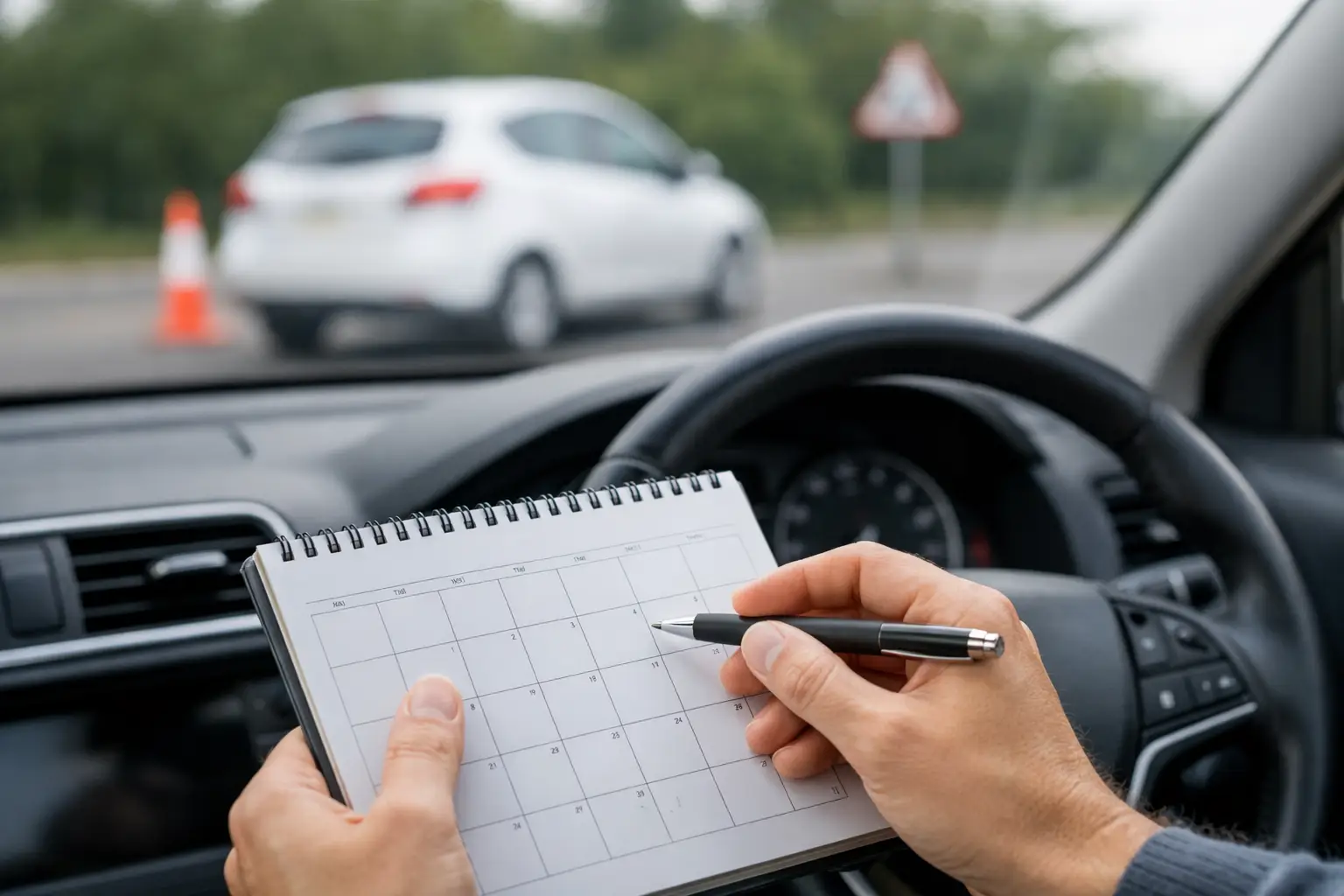
If you keep asking yourself when should I book test, you are probably closer than you think - but booking too early or too late can both make life harder. The sweet spot is not a magic number of lessons. It is the point where your driving is consistently safe, your instructor can see test-level habits forming, and you have enough time to polish the weak bits before the big day.
That is the honest answer learners need. Not the glamorous one, perhaps, but definitely the useful one.
When should I book test - early or later?
For most learners, booking your practical test before you feel 100 per cent ready is actually sensible. That sounds odd at first, but test waiting times can be long, and if you wait until you feel fully prepared before even looking for a slot, you may end up sitting around for weeks or months. Skills can go rusty, confidence can wobble, and your lesson costs can creep up while you wait.
A better approach is to book once you have passed your theory test and your instructor believes you are progressing well enough to be test-ready by that date. In other words, you do not need to be perfect on the day you book. You do need a realistic plan to become test-ready by the day you sit it.
That balance matters. Book far too soon, and you create pressure before the foundations are there. Book far too late, and you risk losing momentum.
The signs you are ready to book your test
A lot of learners assume readiness means making no mistakes at all. That is not how real driving works, and thankfully it is not how driving tests work either. Examiners are looking for safe, legal, controlled driving. Small slips are one thing. Repeated dangerous habits are another.
You are probably ready to book if you are driving safely on a range of roads, handling roundabouts without your brain leaving the building, and making decisions without constant prompts. You should also be able to manage manoeuvres with reasonable consistency, follow signs or sat nav directions, and recover calmly if something unexpected happens.
Confidence matters, but calm matters more. Some learners feel nervous right up to test day and still pass because their driving is solid. Others feel very confident but are not yet checking mirrors properly or planning ahead well enough. Confidence is lovely. Competence is the bit that gets you through.
A good instructor will usually spot the difference quickly. If they are saying, "You are not far off," that is different from, "Let us get your test booked." One means progress. The other means planning.
Why your instructor's view matters
Your instructor is not there to crush your dreams or guard the calendar like a dragon. If they suggest waiting a little longer, it is usually because they can see habits you may not notice from the driver’s seat.
Things like observation at junctions, speed control on unfamiliar roads, lane discipline on busy roundabouts, or hesitation in fast-moving traffic often show up more clearly to an experienced instructor than to the learner doing their best to stay alive. That is normal.
The best time to book is usually when your instructor can say, with a straight face and no dramatic pause, that you are likely to be ready by then. At D4Driving School of Motoring, that is exactly how test planning should work - around your current level, your pace of learning, and the areas that still need sharpening.
Booking after your theory test - not before
You cannot book your practical driving test until you have passed your theory test, so if that has been sitting on your to-do list for months, start there. It is surprisingly common for learners to make great practical progress and then get held back because the theory was treated like an annoying side quest.
Passing your theory earlier gives you more flexibility. It means you can book a practical slot as soon as your driving starts to reach the right standard, rather than scrambling to do everything at once.
If you are still very early in lessons, the best order is usually this: learn the basics of driving, get some road experience, revise theory alongside lessons, pass the theory, then book the practical once your instructor agrees the timing makes sense.
How many lessons before booking?
There is no fixed number, and anyone who gives you one as a promise is guessing. Some learners are ready sooner because they practise privately, pick up skills quickly, or have good road awareness from cycling or years spent observing other drivers closely. Others need longer because nerves are a bigger factor, or because certain skills take more repetition.
For one person, booking after 20 or 25 hours might be realistic because their test is still some weeks away. For another, 40 hours may be the point where booking starts to make sense. For some adult learners returning after a long break, it can be less about lesson count and more about rebuilding trust in themselves.
What matters is not the number. It is the trend. Are you improving steadily? Are the same faults coming up every lesson, or are they reducing? Can you drive in different conditions and still stay safe and composed? Those questions tell you much more than a lesson tally ever will.
The risk of booking too early
Booking too early can feel motivating at first. There is a date in the diary, everyone is excited, and suddenly you are imagining the post-test freedom. Then reality turns up in the form of a tricky roundabout, a rough mock test, or a wobble with independent driving.
If the gap between your current ability and test standard is too big, the booking becomes stress rather than structure. You may start chasing the test instead of building proper habits. That often leads to rushed lessons, unnecessary pressure, and a higher chance of failing for issues that could have been sorted with more time.
There is also the emotional hit. A failed test is not the end of the world, but if it happened because the booking was unrealistic, it can knock confidence more than it needs to.
The risk of waiting too long
On the other hand, some learners delay booking because they want to feel completely ready. Sensible in theory, but not always helpful in practice. If your driving is nearly there and your instructor agrees, waiting too long can create a strange sort of perfectionism. You keep taking lessons, keep polishing, keep saying "maybe next month", and never quite pull the trigger.
That can make test nerves worse. The longer the build-up, the bigger the test becomes in your mind. A practical test is important, yes, but it is still one drive on one day. It should not grow into a mythical event that requires flawless driving worthy of a car advert.
If you are driving to a safe standard most of the time and dealing with mistakes appropriately, that is usually the point to get a date secured.
Test waiting times matter more than people think
One reason this question matters so much is waiting times. In some areas, practical test slots can be hard to get quickly. That means your booking strategy should be realistic, not reactive.
If you are learning around Peterborough, or preparing for a test in places such as Kettering or Grantham, it is worth discussing likely waiting times with your instructor as part of the plan. The right test date is not just about skill level. It is also about availability, your work or study schedule, and how often you can fit lessons in between now and then.
Someone having two regular lessons a week may sensibly book sooner than someone fitting in one lesson every other week. Progress depends on consistency as much as effort.
A simple way to decide
If you want the straightforward version, ask yourself four things.
Have I passed my theory test?
Is my instructor saying I am on track for test standard soon?
Am I driving safely on most lessons without constant help?
Can I fit enough practice in before the test date?
If the answer is yes to all four, booking is probably a sensible next step. If one or two are still shaky, that is not failure - it just means your best move right now is to keep building.
What if you are nervous?
Being nervous does not mean you are not ready. Nearly everyone is nervous. Some people are nervous booking the test, nervous before mock tests, nervous during manoeuvres, nervous when a pigeon looks at them funny - and still go on to pass.
The real question is whether nerves are affecting the safety of your driving in a lasting way. If your instructor can see that you recover well, keep thinking clearly, and do not fall apart every time something changes, you may be more ready than you feel.
That is why patient, tailored instruction matters. Learners do not all build confidence at the same speed, and they should not be pushed as if they do.
Book your test when there is evidence behind the decision, not just emotion. A little fear is normal. A clear plan makes it manageable. And once the date is in the diary, your lessons often become more focused, more purposeful, and strangely enough, more reassuring. The goal is not to feel fearless. It is to become ready anyway.