
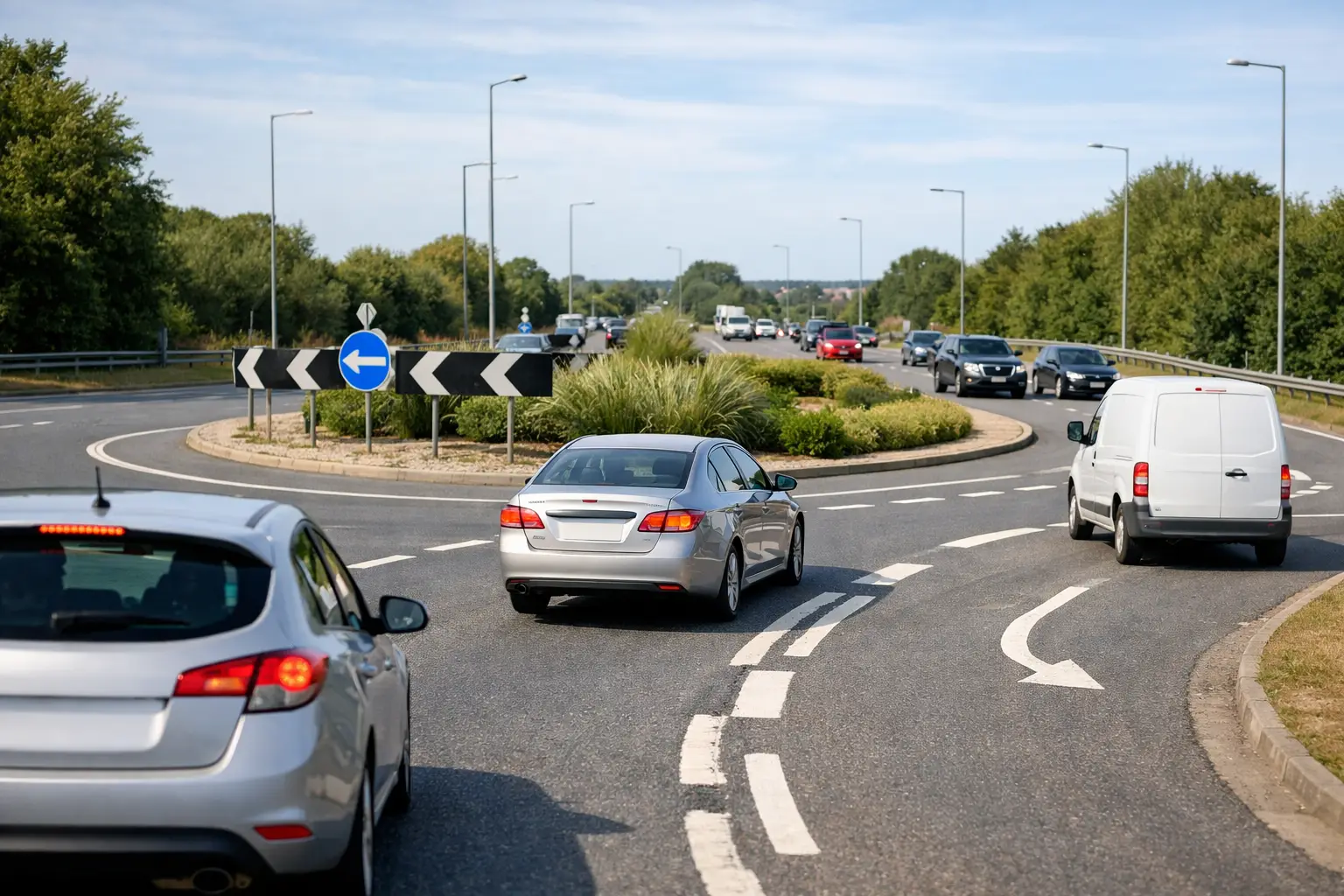
Roundabouts have a talent for making otherwise sensible learners question everything at once. Mirror, signal, speed, lane, exit, other cars, spiral markings, someone indicating left while clearly going nowhere left - it can feel like a lot. A proper roundabout lane discipline lesson Peterborough learners can rely on is not about memorising one magic rule. It is about learning a calm, repeatable method that works on simple mini-roundabouts, busy multi-lane junctions, and the awkward ones that seem to have been designed during somebody’s lunch break.
Why roundabout lane discipline matters so much
Lane discipline on roundabouts is not just a test issue, although it certainly matters there. It is really about reading the road early, choosing the correct position, and giving other drivers clear information about what you are doing. When that part goes wrong, everything else gets harder. You brake late, hesitate, miss safe gaps, drift across markings, or take an exit from the wrong lane and hope for the best. Hope is not a driving plan.
For many learners, the hardest part is that roundabouts combine several skills at once. You need good observation, steady speed control, accurate steering, and the confidence to commit when it is safe. If you are still building those skills, roundabouts can feel fast even when you are moving slowly. That is why focused practice helps. Instead of treating every roundabout as a fresh surprise, you learn a routine that makes them more predictable.
What a roundabout lane discipline lesson in Peterborough should teach
A useful lesson starts before the roundabout itself. Good lane discipline is usually decided by what you do on the approach. If you spot signs and road markings early, you give yourself time to choose the correct lane without rushing. If you leave it too late, you are more likely to weave, stop unnecessarily, or arrive in the wrong position.
The first thing to learn is how to read the junction. Road signs often show the exits and which lane serves them. Painted arrows on the road add another clue. In general, left lane for left or straight ahead, right lane for turning right or going full circle, but roundabouts are not always that tidy. Some have spiral lane markings that guide you outwards as you go round. Others keep the left lane for the first exit only. That is why your instructor should teach you to trust the signs and markings at that junction, not a one-size-fits-all rule.
A good lesson also covers speed and timing. Many lane errors happen because the car approaches too quickly. If you are calm on the brakes and in the right gear, you have more time to observe and steer accurately. It sounds simple because it is simple. Not easy at first, but simple.
The method that keeps things clear
Most learners do well with a set routine. On approach, check mirrors, read the signs, choose your lane, adjust your speed, and decide whether you need to stop or can continue safely. Once on the roundabout, keep to your lane markings, maintain gentle steering, and avoid changing lanes unless the markings clearly direct you to do so.
For signalling, left on approach if taking the first exit, right on approach if turning right, and normally no signal for straight ahead until you pass the exit before the one you want. Then signal left to come off. The key word is normally, because some junctions have unusual layouts and the road markings may suggest something different. Driving well is not about reciting rules without thought. It is about applying them properly to the road in front of you.
One of the biggest confidence boosts comes when learners realise they do not need to rush. You do not win a prize for attacking a roundabout at speed. A steady approach gives you more time to spot lane arrows, cyclists, pedestrians near crossings, and drivers who are a bit optimistic with their indicators.
Common roundabout mistakes and why they happen
The classic error is entering in the wrong lane because the driver looked too late. That often leads to last-second swerving or going the wrong way. Going the wrong way is inconvenient. Swerving is dangerous. If you ever find yourself in the wrong lane, the safer option is usually to stay in it and follow the road, then re-route afterwards.
Another common mistake is drifting across lanes while looking right. This happens because the learner focuses so hard on finding a gap that steering accuracy disappears. The fix is not just “steer better”. It is reducing the workload by approaching slower, planning earlier, and using your vision properly. Quick glances for traffic, then eyes back to where the car needs to go.
Some learners also hesitate too long when a safe gap appears. That usually comes from uncertainty rather than poor judgement. They have not yet built the habit of deciding and moving smoothly. Patient coaching helps here. So does practising on roundabouts of different sizes, because confidence grows when you see the same method work again and again.
Then there is signalling. Drivers sometimes leave the right signal on too long, fail to signal left to exit, or signal left while still continuing round. Other road users may forgive a little clumsiness, but they cannot read minds. Clear, timely signals make the whole junction calmer.
Why local practice makes a difference
A roundabout lane discipline lesson Peterborough learners take locally has a real advantage. You are not learning in the abstract. You are working on the roads you are likely to use in lessons, private practice, and possibly on the driving test. That means you can get used to different layouts, traffic levels, lane markings, and approaches without adding the stress of unfamiliar roads every five minutes.
Local tuition also makes it easier to build difficulty gradually. You might begin on quieter roundabouts where the focus is purely on lane position and observations. Then you can move on to busier junctions where timing and decision-making matter more. That step-by-step approach suits nervous learners and refresher drivers particularly well. Confidence tends to grow when each lesson feels challenging but manageable, not like being thrown into the deep end with a sat nav and a prayer.
How Robert builds up roundabouts in Peterborough
Lane discipline can be taught at any multi-lane roundabout, so Robert raises the difficulty gradually. That way students don't feel overwhelmed by the traffic.
- Start in Bretton or Ravensthorpe. Robert usually begins with the roundabouts there.
- Then the traffic-controlled roundabout near the City Hospital. You move on to this one once you feel more confident.
- Then the Junction 20 Spiral Roundabout and Eye Services Roundabout. These come after you've mastered the City Hospital roundabout.
From Robert's notes on the Peterborough test routes: the Junction 20 Spiral Roundabout catches out students who can't keep good lane discipline, and on the approach to Eye Services Roundabout from Werrington, learners are often caught out by the 40 speed limit. Two more that reward good lane discipline are Rivergate Roundabout, where you choose your lane on the approach and then steer precisely to stay in it, and Hampton Roundabout, where you follow the guide lanes all the way round, especially when turning right from Fletton Parkway into Nene Parkway.
Manual or automatic - does it change the lesson?
The lane discipline itself stays the same. The road does not care whether you are in a manual or an automatic. What changes is your workload. In a manual car, you are also managing clutch control and gear selection on approach, which can make busy roundabouts feel more demanding early on.
In an automatic, some learners find it easier to focus on positioning, observation and timing because there is less to think about with the car itself. That can be a real benefit if nerves are your main obstacle. On the other hand, manual learners often find that once gear changes become more natural, their confidence at roundabouts improves quickly too. It depends on where your mental effort is currently going.
How tailored lessons help nervous learners most
Not everyone struggles with roundabouts for the same reason. One learner is worried about choosing the wrong lane. Another is fine with lanes but freezes when traffic is busy. Someone else had a bad experience before and now expects every roundabout to go wrong. Good teaching adapts to that.
A personalised lesson might start with diagrams and talk-throughs if you need the logic explained clearly. It might use repeated practice on one junction until the routine feels natural. It might slow everything down and focus on just one skill, such as approach planning, before building the full sequence back in. That kind of patient structure tends to produce better progress than simply doing more roundabouts and hoping confidence appears by accident.
At D4Driving School of Motoring, the aim is exactly that - calm, one-to-one coaching that meets you where you are and helps you improve lesson by lesson.
What progress looks like in real terms
You do not need every roundabout to feel easy straight away. Real progress often looks smaller and more useful than that. You spot lane signs earlier. You stop second-guessing your position. You take safe gaps with less hesitation. You exit in the correct lane without your shoulders ending up somewhere near your ears.
That is how confidence actually grows. Not through big speeches, but through repeated evidence that you can handle the situation safely. Once learners feel that shift, roundabouts stop being the part of the lesson they dread and start becoming just another road feature to deal with properly.
If roundabouts are currently the bit you are bracing for, that is fixable. With clear instruction, local practice and a lesson paced around how you learn, lane discipline becomes far less mysterious and far more manageable. Start with one roundabout, one routine, and one calm decision at a time.