
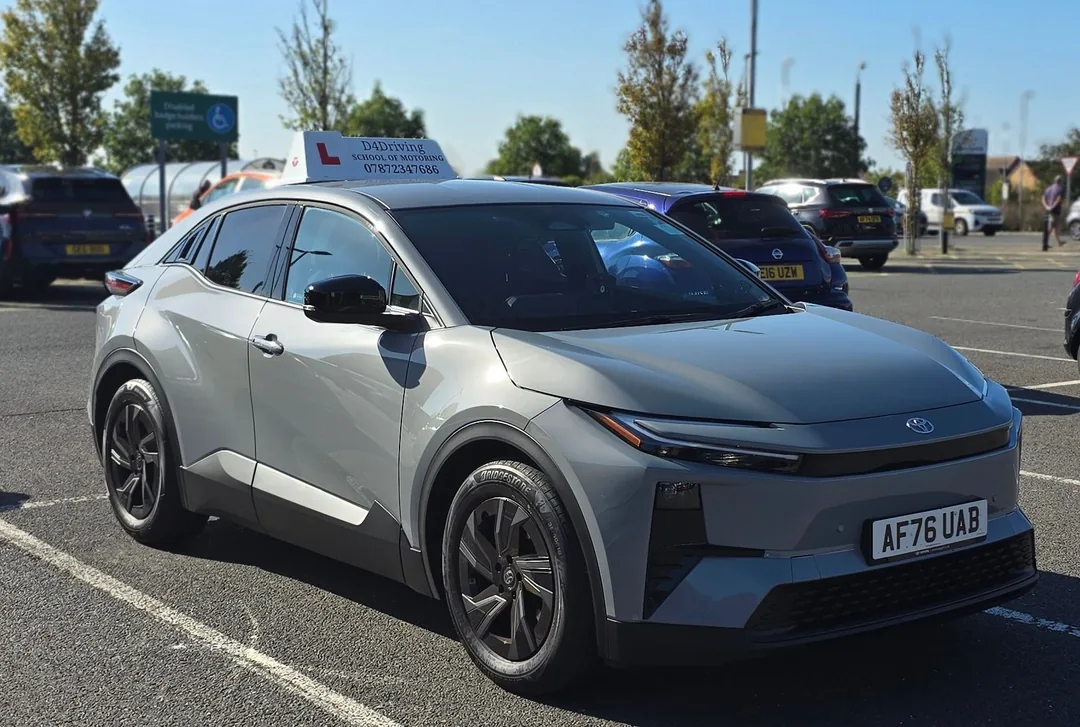
Got a practical driving test booked at the Peterborough test centre? This guide takes you through the day from start to finish: getting there, parking, the waiting area, what the examiner does before you drive, what happens on the road, and what comes after the result. The local detail comes from Robert, who takes his pupils to this centre for their tests. The rules come from DVSA and GOV.UK, with links so you can check them yourself.
Peterborough test centre at a glance
- Address: Second Drove, Fengate, Peterborough PE1 5XA. Open in Google Maps
- Pass rate: 52.8% from April 2025 to March 2026 (10,551 tests), against 50.0% across Great Britain. Source: DVSA test centre data.
- Facilities: a small car park with one disabled bay, a waiting area for about 10 people, toilets and a water fountain.
- Arrive: don't drive into the car park more than 10 minutes before your test time.
Getting to the test centre
Second Drove is a busy road leading into an industrial area, with lots of warehouses and heavy traffic, so give yourself time and don't rush the last few minutes.
The centre's rule is that you don't enter the car park more than 10 minutes before your test time, because cars coming and going can affect people who are still on their test. If you arrive too early, Robert's tip is to drive on past the test centre towards the gate at the end of the road, by the rugby club. Turn around before the gate and park on the left wherever there's a space. Be warned that spaces there can be hard to find, as there are usually a lot of cars parked.
Parking at the centre
The Peterborough centre isn't a big one, and the car park is quite small, with only one disabled bay. As you come through the main gate:
- The spaces on your right are for the examiners. Don't park there.
- Further ahead on the left are the spaces for motorcycles.
- Candidates, whether they've come with their instructor or a supervising driver, reverse into any bay to the left of the main gate.
In the waiting area
Once you've parked, go into the main building and wait in the waiting area. It isn't large, but it easily holds about 10 people, and there are toilets and a water fountain. An examiner will come and call you by name.
- Have your provisional licence ready before you're called. The examiner checks your details on a tablet.
- You'll sign a declaration. Make sure your signature looks the same as, or very close to, the one on your provisional licence.
- You'll be asked if you want anyone to come with you as an observer. That can be your instructor or whoever came with you. You don't have to take anyone.
Robert leaves that last decision to each student. Most of the time he waits at the test centre for them to come back, though he's happy to go along if they'd like him to. Most students want him there at the end, for the examiner's debrief.
Before you drive: the eyesight check and a "tell me" question
The examiner takes you outside to read a number plate from 20 metres away (20.5 metres for an old-style plate). If you normally wear glasses or contact lenses for driving, bring them. If you can't read the plate, the test won't go ahead.
Then the examiner explains the test and asks you a "tell me" question about a safety check on the car. You can't fail just for not knowing the answer, but it is marked on your test sheet, so it's worth knowing them all. You'll then go to your car and the test starts.
On the road
GOV.UK says the test lasts about 35 minutes. In Robert's experience at Peterborough, it usually lasts between 38 and 40 minutes, on several different types of road. During the drive:
- You'll be asked a "show me" question while you're driving, such as working the rear heater or washers.
- There's about 20 minutes of independent driving, following a sat nav set up by the examiner or road signs. Going the wrong way isn't a fault in itself; if you miss a turn, the examiner will get you back on track.
- You'll do one reversing manoeuvre: a parallel park, a bay park, or pulling up on the right and reversing about two car lengths. At Peterborough, bay parking is usually done in the test centre car park or the nearby Lido swimming pool car park.
- You might be asked to do an emergency stop.
To pass, you need no more than 15 driving faults (minors) and no serious or dangerous faults. For the roads and roundabouts the Peterborough routes use, and where learners get caught out, see Robert's Peterborough driving test prep guide, or explore the interactive test routes.
Watch a Peterborough test route on Robert's YouTube channel.
The result, and afterwards
When you're back at the centre, the examiner tells you the result and goes through any faults. If you pass, you'll get a pass certificate, and the examiner can send your full licence to you automatically. If you don't pass this time, you can book another test for at least 10 working days later.
Whichever way it goes, Robert drives his student back to wherever they'd like to go afterwards.
Your car for the test
The test centre doesn't provide cars. You come either with your instructor in their car, or in a car with your supervising driver. If you use your own car, it must be roadworthy, taxed, have an MOT if it needs one, and be insured for a driving test. GOV.UK lists more rules too, including L plates on the front and back, an extra interior mirror for the examiner, and no safety warning lights on the dashboard. Check the full list on GOV.UK: using your own car.
Robert doesn't normally lend his car for a test to someone who hasn't had lessons with him first. He has to be sure a student can drive safely and legally before he hands over the keys.
What to bring
- Your provisional driving licence. If you don't have a photocard licence, bring a valid passport and your paper licence.
- Your glasses or contact lenses, if you need them for driving.
- Proof of any change of name, such as a marriage certificate.
If you forget something you need, your test will be cancelled and you'll lose the fee. See GOV.UK: what to take to your test.
The week before your test
Robert's advice for the week before is simple: stop overthinking the test. Try to relax and treat it like a normal lesson. You won't be asked to do anything you haven't already covered in your lessons. If you'd like a drive on the day to settle your nerves, see what happens in a warm-up lesson before your Peterborough test.
Bad weather, and changing your test
Bad weather: tests don't go ahead in dangerous conditions such as ice, flooding, thick fog or high winds. If the weather is bad on the day, call the test centre on the number in your booking confirmation email. If your test is cancelled, DVSA books the next available date for you and sends the details, usually within 3 working days. See GOV.UK: bad weather.
Changing or cancelling: you have to change your test yourself, and you can change it twice before you'd need to cancel and rebook. Give at least 10 full working days' notice (Monday to Saturday count) or you'll lose the fee. See GOV.UK: change your driving test.
Driving test myths that aren't true
Plenty of test-day worries come from myths. Examiners care about safe, controlled driving, not made-up rules.
- "Stalling is an automatic fail." It isn't. It's usually a minor driving fault. It only becomes serious if it keeps happening, you panic, or you stall somewhere dangerous, such as rolling back at a busy junction.
- "You must use push-pull steering." You don't. Crossing your hands is fine, as long as your steering is smooth, safe and under control.
- "Touching the kerb is an automatic fail." In a 2025 survey for the AA, 56% of drivers thought so (the AA's findings). If you gently brush the kerb while parking and put it right safely, without mounting it or making a pedestrian move, it may only count as a minor fault.
- "Taking a wrong turn means you fail." It doesn't. Follow the road signs safely, stay calm, and the examiner will guide you back.
- "Examiners have pass quotas." They don't. There's no daily, weekly or monthly quota. Everyone is marked on their own driving.
- "Driving slowly is safer." Creeping along well below the limit won't impress the examiner. Not making progress when it's safe to can hold up traffic and can cost you the test.
- "You have to exaggerate your mirror checks." Robert's advice: you don't need to swing your head round to prove to the examiner that you're checking your mirrors. Exaggerated movements can actually distract you from the road ahead.
- "You can't wear sunglasses." You can, if the sun is low or dazzling.
- "The radio has to be off." Robert says the radio can be on, playing softly, as long as you can still clearly hear the examiner's instructions.
Frequently asked questions
Where is the Peterborough driving test centre?
On Second Drove, Fengate, Peterborough PE1 5XA, in an industrial area off a busy road.
What is the pass rate at Peterborough?
52.8% from April 2025 to March 2026, slightly above the 50.0% average across Great Britain, according to DVSA's published data.
How early should I arrive?
Don't drive into the test centre car park more than 10 minutes before your test time. If you're early, wait further along Second Drove rather than in the car park.
Can my instructor come on the test with me?
Yes, if you'd like. The examiner will ask whether you want an observer, such as your instructor or the person who came with you. You don't have to take anyone.
Want to feel ready on the day? Robert's Peterborough test prep is four full hours of focused training on Peterborough test routes and manoeuvres.