
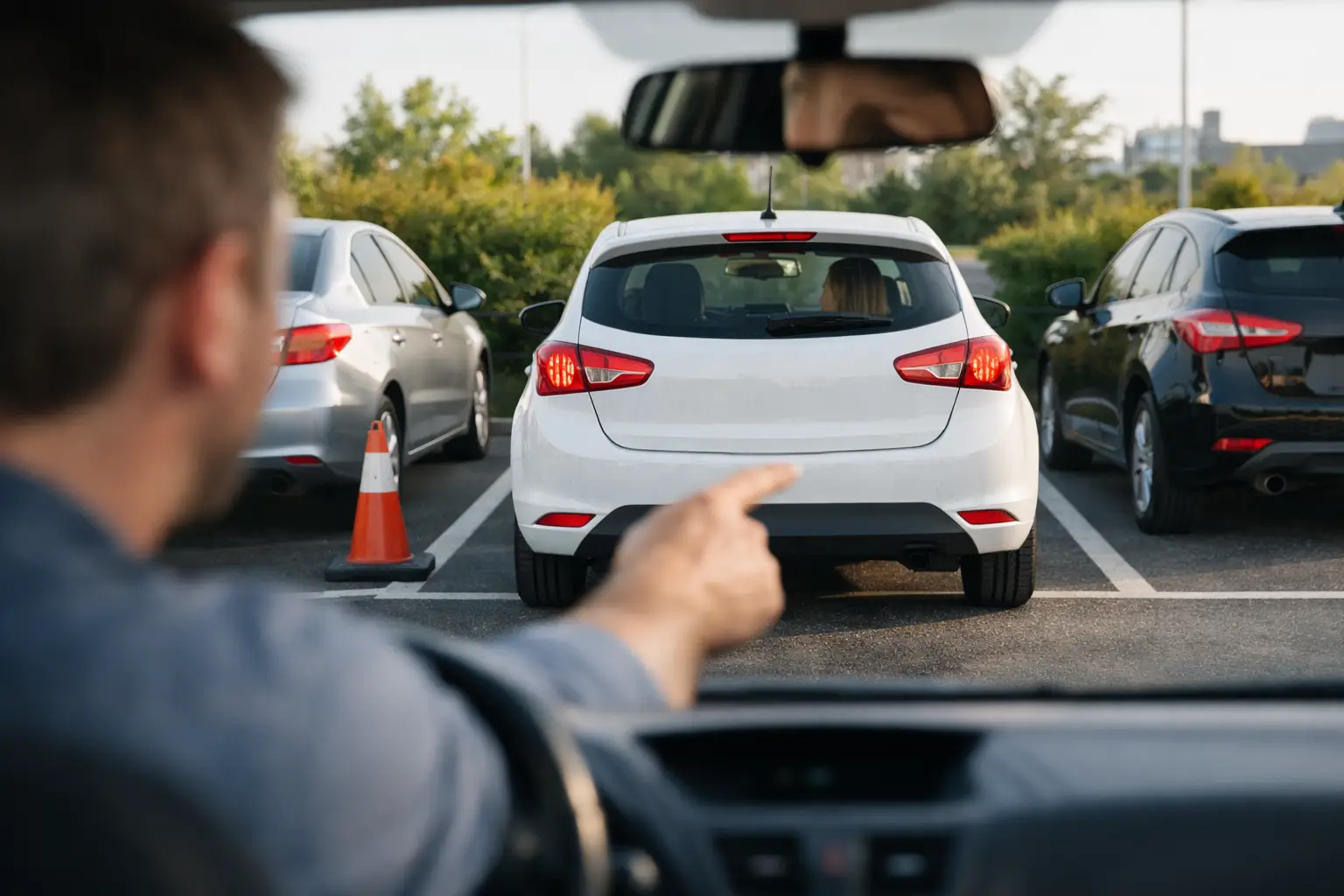
That awkward moment in a lesson when the bay seems miles away, the lines start playing tricks on your eyes, and suddenly your hands forget what the steering wheel is for - yes, that’s usually where bay parking reference points for learners become very useful. They give you a repeatable way to judge when to turn, when to stop, and how to straighten up without relying on guesswork. And when you’re nervous, less guesswork is always a good thing.
The first thing worth saying is this: reference points are a training aid, not magic. They help you build consistency while you’re learning, but they only work properly when combined with slow control, good observation, and understanding what the car is doing. If you memorise a routine without knowing why it works, it can fall apart as soon as you change car, bay size, or starting position.
How bay parking reference points for learners actually help
Most learners struggle with bay parking for the same reason. You are sitting on one side of the car, trying to place the whole vehicle into a marked space, while moving slowly enough to steer accurately and observe all around. That is a lot to juggle at once.
Reference points reduce that mental load. Instead of thinking, “I hope this looks about right,” you use clear visual markers from your mirrors, windscreen, door handles, dashboard or side windows to guide each stage. Done properly, they make the manoeuvre feel more structured and far less random.
They are especially helpful for nervous learners and for anyone preparing for the practical test, because they create a starting framework. Once that framework is in place, your confidence usually improves quite quickly. You stop feeling as though parking is something that just happens to you.
The key thing learners often miss
A reference point is only reliable if your starting position is reliable too. If you begin too close to the bays, too far away, or at a different angle from the one you practised, your usual turning point may no longer work.
That is why instructors spend time setting the car up properly before the manoeuvre. It can feel fussy at first, but it saves a lot of correction later. A neat setup gives you the best chance of using your reference points consistently.
Speed matters as well. Bay parking should be done slowly - properly slowly. If the car is creeping, you have time to steer, check around, and correct safely. If it is rolling too quickly, even a perfect reference point will not save a scruffy finish.
Forward bay parking reference points
With forward bay parking, many learners are taught to position the car so there is a sensible gap from the parked vehicles or bay lines, usually around a door’s width or a little more. The exact spacing depends on the vehicle, but the principle is simple: give yourself enough room to turn without cutting in too sharply.
A common reference point is when the first bay line or the centre of the target bay appears in line with a chosen point on the car, often somewhere near the door mirror or a point on the dashboard. At that moment, you begin steering into the bay. The goal is to bring the front of the car round smoothly and then straighten the wheel when the vehicle is lined up.
This is where learners often turn either too early or too late. Too early, and you clip across the near line. Too late, and the car ends up wide or needs an extra shuffle. Neither is a disaster in a lesson, by the way. It just tells you what to adjust next time.
Once the car is entering the bay, look where you want the car to finish, not just at the line nearest you. Your mirrors will help you judge both sides, and a quick forward glance helps you keep the nose straight. If the bay lines appear to open evenly on both sides, that is usually a good sign.
Reverse bay parking reference points for learners
Reverse bay parking tends to worry learners more, but in many ways it is the more controllable manoeuvre. The reason is simple: when reversing, the steering has a stronger effect on the direction of the car, which can actually help you place it more accurately once you understand the timing.
A typical method starts with the car parallel to the bays and a consistent distance out from them. Many learners use a point on the side of the car - often the rear door handle, mirror, or a point in the side window - lining up with the bay line before full steering is applied.
As the car begins to reverse, you use the mirrors to watch the bay lines appear. This is where the reference points really earn their keep. You are looking for the moment when the line meets a familiar marker in the mirror or side window, which tells you when to steer and when to unwind the wheel.
The exact point differs from car to car, and that is perfectly normal. A smaller hatchback will not behave exactly like a larger vehicle, and manual and automatic cars may feel slightly different in pace and control. That is why good instruction matters. The best reference points are the ones that work for your car and your seating position, not the ones your mate insists are “the only way”.
Why one learner’s reference points may not work for another
This catches people out all the time. You watch a video, copy the routine exactly, and then wonder why you end up parked like you’ve abandoned the car mid-thought.
There are a few reasons. Seat height changes your view. Mirror adjustment changes what you can see. Different cars have different window shapes, bonnet lengths and turning circles. Even the car park itself makes a difference, because some bays are wider, narrower, angled, or simply faded enough to test anyone’s patience.
So yes, use reference points - but treat them as personalised coaching tools. They should be adapted to you. That is how they become reliable.
What examiners actually want to see
Learners sometimes think bay parking is all about finishing bolt upright in the centre of the space with military precision. Neatness matters, of course, but safety and control matter more.
On test, the examiner is looking for effective observation, steady speed, and a safe final position within the bay lines. Small adjustments are allowed. In fact, making a calm correction is often better than forcing a bad position and hoping for the best. Hope is not a parking technique.
Before, during and after the manoeuvre, you need to keep checking around the car. That includes mirrors and blind spots where appropriate, especially if there are pedestrians, moving vehicles, or trolleys drifting about with a mind of their own. A technically tidy manoeuvre with poor observation is not a good manoeuvre.
How to practise without making it harder than it needs to be
The best practice sessions are simple and repetitive. Pick a quieter car park, start with the same bay type, and repeat the same setup several times. That gives you a fair chance to notice patterns. If you change everything every attempt, it is much harder to work out what caused a good result.
After each try, ask yourself three questions. Was my starting position consistent? Did I steer at the right moment? Did I keep the car slow enough to make corrections? Those answers are usually more useful than saying, “I’m just bad at parking.” Most of the time, you are not bad at parking. You are just still learning the timing.
If you are having one of those lessons where every bay parking attempt goes a bit wrong, that is normal too. Progress is rarely a straight line. One session it clicks, the next it feels odd again, then suddenly your hands and eyes start working together and the manoeuvre settles down.
Building confidence with bay parking reference points for learners
Confidence does not usually arrive first. Competence does, then confidence follows. That is a far better order, because it means your confidence is based on something real.
When learners practise bay parking with clear reference points, they stop relying on luck and start recognising cause and effect. Turn here, check there, straighten now. That understanding makes you calmer, and calm drivers make better decisions.
If you are learning in Peterborough or getting ready for test routes in places like Kettering or Grantham, practising with an instructor who can tailor those reference points to your car and your style of learning makes a genuine difference. A patient explanation at the right moment can save weeks of frustration.
Bay parking is not about being perfect on the first attempt. It is about building a method you can trust, then refining it until the bay stops looking like a trap and starts looking like just another part of driving. Keep it slow, keep observing, and let the reference points support you rather than control you. Before long, you will be parking up with far less drama - and with any luck, no audience watching from the nearest car.