
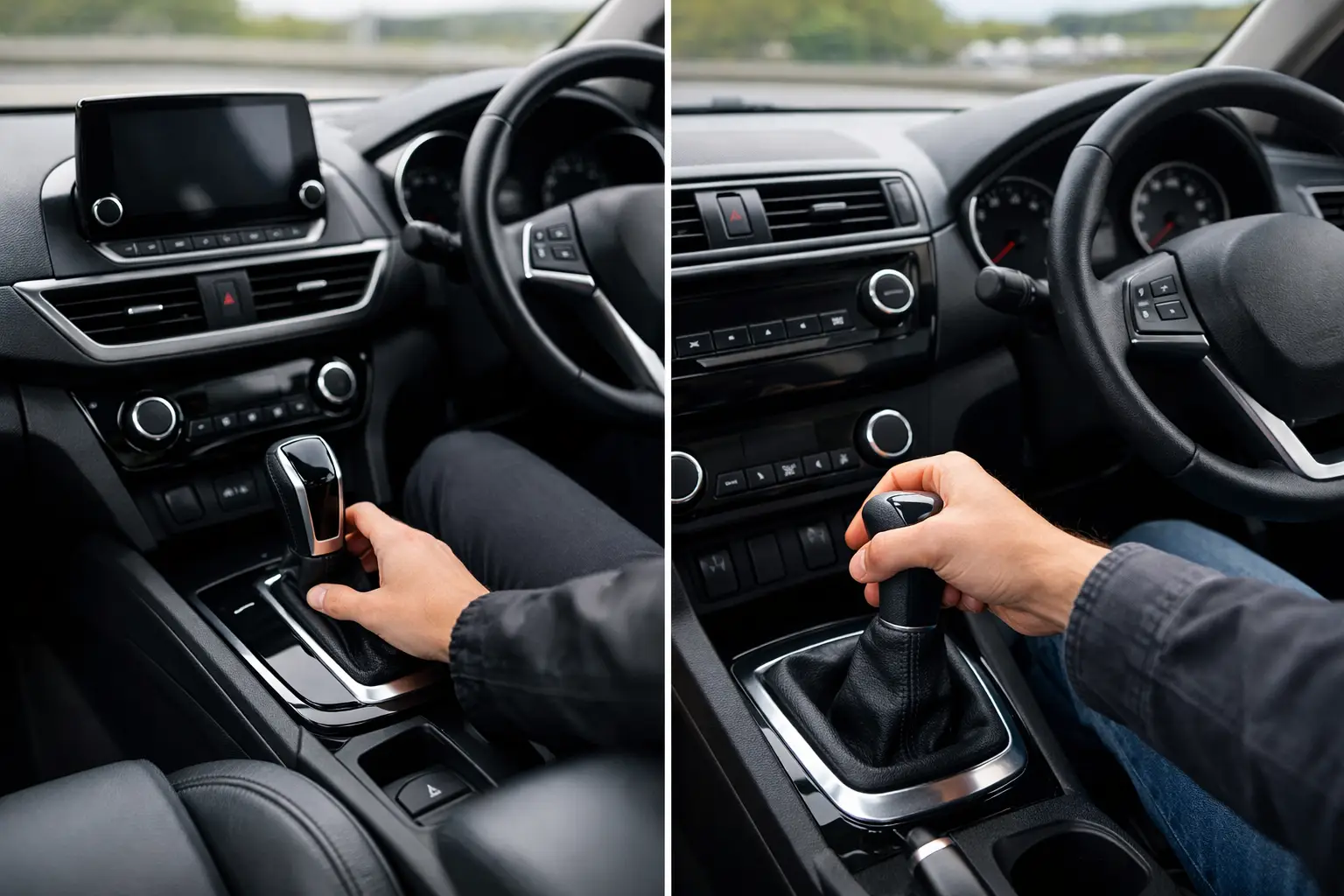
Your first lesson should feel like the start of freedom, not a test of whether you can coordinate three pedals before breakfast. The automatic licence versus manual licence decision affects the car you learn in, the skills you practise and the vehicles you can drive after passing. Neither route is a shortcut to being careless or a badge of being a better driver. The right choice is the one that helps you become safe, confident and ready for the roads you will actually use.
Automatic licence versus manual licence: the key rule
The difference is straightforward. If you pass your practical driving test in a manual car, you can legally drive both manual and automatic cars. If you pass in an automatic car, your licence is restricted to automatic vehicles.
That restriction does not mean you have a lesser licence. It simply reflects the fact that you have not been tested using a clutch and manual gears. Should you later need or want to drive a manual vehicle, you can take further lessons and pass another practical test in a manual car. You do not need to retake your theory test.
For many learners, this is the main deciding factor. A manual licence gives the widest choice of vehicles. An automatic licence gives a more focused route into driving, often with less mechanical workload during lessons. The best option depends on your plans, your confidence and how you learn.
What changes behind the wheel?
In a manual car, you use the clutch with your left foot and select gears with your left hand. You must learn to move off smoothly, match the right gear to your speed, change down when necessary and manage hill starts without rolling backwards. These are learnable skills, but they take practice. Everyone stalls at some point. It is practically part of the furniture on an early manual lesson.
An automatic car does the gear changes for you. You select Drive, Reverse, Park or Neutral, then use your right foot for the accelerator and brake. This allows many learners to give more attention to mirrors, speed, road position, signs and what other road users are doing.
That does not make automatic lessons effortless. You still need sound judgement, good observation and proper control. You still have to handle roundabouts, meet traffic safely, park accurately and make independent decisions. The driving test assesses the same standards whichever transmission you choose. An automatic simply removes clutch control and gear selection from the task list.
Why some learners progress faster in an automatic
Automatic tuition can suit nervous beginners, learners who found manual lessons frustrating, and people returning to driving after a long break. With fewer actions to manage when approaching a busy junction, it can be easier to stay calm and take in the road ahead.
This can be especially helpful when lessons take place around varied local roads, where traffic lights, roundabouts, parked cars and changing speed limits demand your attention. A calmer learner is often better able to absorb feedback and build consistent habits.
However, quicker is not guaranteed. Safe driving is more than operating the car. A learner who rushes decisions, misses observations or struggles with planning will still need time and patient practice. The aim is not merely to pass quickly. It is to pass with the confidence to drive independently the following week.
When a manual licence may be the better choice
Choose manual if having the broadest possible vehicle choice matters to you. You may expect to share a family car, borrow a friend’s vehicle, buy an older used car or need a manual for work in the future. Although automatics are increasingly common, manual cars remain on many driveways and in some workplace fleets.
A manual licence can also offer more flexibility when comparing used cars. Depending on the model, age and local market, there may be more manual options available within a particular budget. Insurance, fuel and purchase prices vary significantly by car and driver, so it is worth looking at the type of vehicle you realistically expect to own rather than relying on a general rule.
Some learners simply enjoy learning the extra skill. Once clutch control clicks, manual driving can feel natural and satisfying. It takes patience, especially at first, but it is not beyond anyone who learns at a steady pace with clear instruction.
The trade-off is that manual lessons may require more time before you feel fully comfortable in busier situations. You are building all the same road-awareness skills as an automatic learner while also learning how to manage the gears.
When an automatic licence could be right for you
An automatic licence is a sensible choice if your priority is getting on the road confidently in an automatic car. This is increasingly practical as electric vehicles and many hybrid cars are automatic. If you know your household car is automatic, or you plan to choose an automatic when you buy one, there is no need to learn a manual purely because other people think you should.
It may also be the right route if you have already had several manual lessons and clutch control is preventing you from enjoying the wider learning process. Changing transmission is not giving up. It is choosing the learning environment in which you can concentrate and progress.
Automatic driving can be particularly appealing for people who will spend time in stop-start traffic. Without repeated clutch work and gear changes, the car is easier to manage in queues. That said, no gearbox can make heavy traffic fun. It can only remove one source of effort.
Before committing, think honestly about whether you might need to drive a manual within the next few years. If the answer is likely, a manual course may save you from needing an additional test later. If the answer is no, automatic can be a practical and confidence-building decision.
Is one driving test easier than the other?
The test route, marking and required standard are the same. Examiners are looking for safe, responsible driving, not whether you have a gear lever. You must show effective observations, appropriate speed, anticipation, positioning, manoeuvres and the ability to drive independently.
Manual candidates can make faults connected to gears or stalling if those errors affect control or other road users. Automatic candidates avoid those particular issues, but they can still receive faults for poor braking, coasting, lack of control, inappropriate speed or missed checks. Passing comes from making safe decisions consistently.
For this reason, choosing an automatic because it feels less overwhelming can be completely valid. But it should be paired with structured lessons, practice between sessions where possible, and an instructor who explains not just what to do, but why you are doing it.
How to make the decision without second-guessing yourself
Start with the car you expect to drive after passing. If it is definitely automatic, that points strongly towards automatic lessons. Next, consider your long-term flexibility. If work, family or budget could require a manual car, learning manual now may be worthwhile.
Then consider how you respond to learning. A learner who enjoys a challenge and has time to practise may be happy with manual. Someone balancing work, children, anxiety or a deadline may benefit from reducing the initial workload in an automatic. There is no prize for making your driving journey harder than it needs to be.
A good instructor can help you decide after an honest conversation and, where appropriate, an introductory lesson. At D4Driving School of Motoring, lessons are tailored to your starting point and goals, whether that means carefully building manual clutch control or helping you feel settled and capable in an automatic.
The licence matters, but your confidence matters more
Your transmission choice is only one part of becoming a capable driver. The habits that keep you safe - checking properly, reading the road early, leaving space and staying composed when plans change - matter in every vehicle.
Choose the licence that supports those habits and suits the life you want after your test. With patient guidance and steady practice, your first independent drive can feel less like a leap into the unknown and more like exactly what it should be: your next confident step towards freedom.