
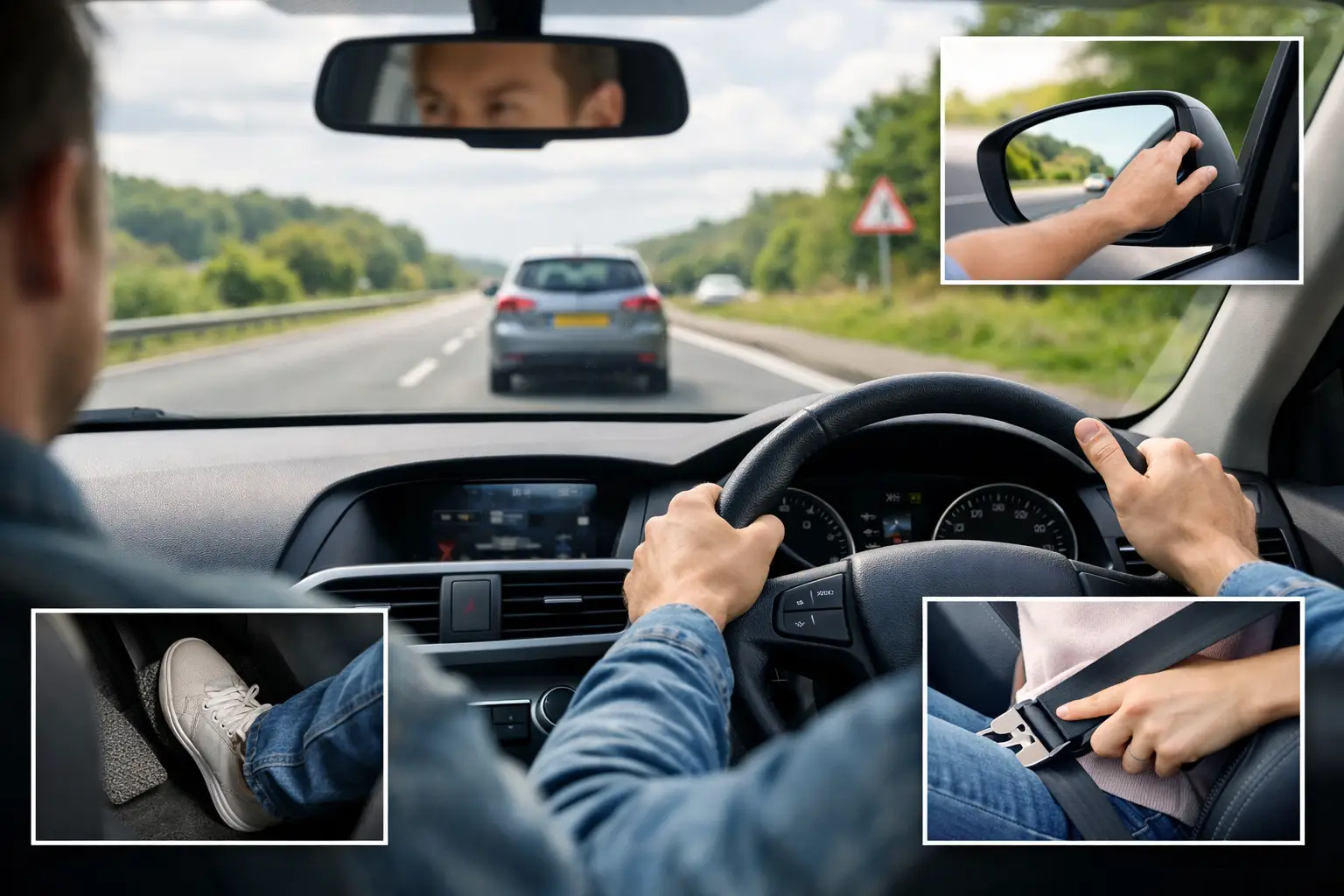
Most learners do not struggle because they cannot steer or change gear. They struggle because driving asks you to do small things well, every single time, even when the road gets busy, the sat nav starts barking, and someone behind seems personally offended by the speed limit. That is why safe driving habits lessons matter so much. Good habits take the pressure off. They turn driving from a scramble into a routine.
At the start, many people think safe driving means reacting quickly. Sometimes it does. More often, it means not needing a dramatic reaction in the first place. The safest drivers tend to look early, plan early and leave themselves options. That is less flashy, but far more useful on a wet roundabout in Peterborough than feeling brave for three seconds.
Why safe driving habits lessons work better than quick fixes
A lot of driving advice online sounds simple until you are actually in the car. "Just be confident" is not much help when you are approaching a busy junction and trying to remember mirrors, signal, speed and position all at once. Habits are different. They give you a repeatable pattern.
This is why personalised teaching makes such a difference. One learner needs more time on clutch control. Another is fine with the car but hesitant at roundabouts. Someone returning to driving after years away may know the rules but need to rebuild trust in their own judgement. The lesson is not just about what to do. It is about doing it often enough, in the right order, until it feels natural.
Safe driving is also not one giant skill. It is a set of smaller behaviours that support each other. If your observations improve, your speed choices usually improve too. If your following distance is sensible, your braking gets smoother. If you plan earlier, your nerves often settle down because fewer things feel last minute.
The safe driving habits lessons every learner should build
1. Observation before action
The mirror check is not there to decorate the routine. It tells you what is happening around you before you change anything. Before moving off, slowing down, turning, changing lanes or overtaking, you need an accurate picture of the space around the car.
New drivers sometimes treat mirrors like a box to tick. A quick glance, job done. But useful observation has timing. Check too early and the information goes out of date. Check too late and you are already committed. This is where practice matters. You are building the judgement to know when the glance gives you information you can act on.
Then there is the windscreen view, which deserves more credit than it gets. Good drivers scan ahead, not just at the patch of road directly in front of the bonnet. A pedestrian near a crossing, brake lights three cars ahead, a cyclist wobbling near the kerb - these clues let you prepare calmly instead of reacting sharply.
2. Speed that matches the road, not your mood
Learners often hear "make progress" and accidentally translate it as "hurry up". They are not the same thing. Safe progress means choosing a speed that suits the limit, the road layout, traffic, visibility and conditions.
A dry, open road at 30 mph is one thing. The same road in heavy rain, near parked cars or around school finishing time is another. This is where safe driving habits lessons earn their keep. You learn that the speed limit is the maximum in ideal conditions, not a target that must be hit at all costs.
Driving too slowly can also create problems if it shows hesitation or disrupts traffic unnecessarily. So yes, it depends. The skill is not simply going slower. The skill is choosing the right speed early enough that the rest of your driving stays smooth and controlled.
3. Space is your best safety feature
Cars come with brakes, mirrors, lights and enough warning noises to make you feel told off by your own dashboard. Useful, all of them. But space is still your best safety feature.
Leaving a proper gap from the vehicle in front gives you time to see, think and respond. It also makes your driving smoother, because you are not constantly tapping the brake every time traffic compresses. The same applies at junctions, near cyclists and when passing parked cars. If you squeeze situations, you create stress. If you give them room, you give yourself choices.
Many learners are surprised by how often problems come from being too close rather than too fast. Tailgating reduces your view, limits your reaction time and turns a small issue ahead into a bigger one for you. Keeping space is not timid. It is sensible.
Building confidence without becoming casual
Confidence is helpful. Overconfidence is expensive.
One of the most useful lessons for any driver is learning the difference. Real confidence comes from habits you can trust. You know you check properly. You know you plan your approach. You know you can slow the car smoothly and make a decision without panicking. That kind of confidence is quiet.
Casual driving looks different. It tends to show up once something starts feeling familiar. A learner nails a few roundabouts and suddenly stops taking a proper look. A driver who has parked neatly all week starts rushing the final checks. Familiarity can make people sloppy if they are not careful.
This is why patient instruction matters. The goal is not just to help someone get through this week's lesson or pass the test next month. It is to build routines that still hold up when nobody is sitting beside them reminding them to check the blind spot.
Safe driving habits lessons for nerves, distractions and pressure
Nervous drivers often assume they need to "calm down" before they can drive well. Usually the order is the other way round. When your routine improves, your nerves reduce because there is less chaos in the process.
Take junctions as an example. A nervous learner may approach too quickly, realise late that the view is limited, brake harder than planned and then feel flustered. With coaching, the routine changes. Better observation, earlier speed adjustment, proper position, then a calm decision. The junction has not changed. The process has.
Distractions are another big one. Passengers, phones, music, road signs, weather, thoughts about the examiner - they all compete for attention. Safe drivers are not people with superhuman concentration. They are people who protect their attention.
That means phones out of reach, not just face down "for a quick glance if needed". It means setting the sat nav before moving off. It means accepting that if traffic gets complex, the conversation in the car can wait. There is no prize for being socially excellent while dealing with a spiral roundabout.
Pressure from other road users also catches learners out. Someone sits too close behind. Another driver waves you through when you are not sure it is safe. A car appears from nowhere and turns a calm plan into a rushed one. In those moments, your habits need to be stronger than the pressure. You are allowed to take the extra moment to assess. You are allowed to say no to a risky gap. You are certainly allowed to ignore the theatrical sighs of the car behind.
Practising safe habits between lessons
Progress usually comes faster when learners treat each drive as a chance to repeat good routines rather than perform perfectly. Perfection is a terrible teacher because one mistake can make you feel as if the whole drive was a disaster. It rarely is.
A better approach is to focus on one or two habits at a time. On one drive, you might concentrate on mirror timing and keeping a steady following distance. On another, you might focus on planning for hazards earlier. Small targets are easier to measure, and measurable progress builds confidence properly.
If you are learning in the Peterborough area, this can be especially useful on routes with mixed traffic conditions, where one short drive can include residential roads, busier junctions and faster stretches. Variety helps, but only if you are not trying to fix everything at once.
It also helps to talk through your decisions, even quietly to yourself. Not a full commentary performance worthy of the West End, just enough to keep your mind organised. "Pedestrian ahead, easing off." "Parked cars on the left, checking mirrors." That simple habit can sharpen awareness and reduce rushed decisions.
What a good instructor should be teaching
A good lesson is not just a route with commentary. It should be tailored to your level, your weak points and your pace. Some learners need repetition to settle nerves. Others need challenge so they stop overthinking every turn of the wheel.
The right instructor will teach safe driving habits lessons in a way that makes progress visible. You should know what you are working on, why it matters and what improvement looks like. That might mean practising the same skill in different traffic conditions, or breaking a difficult task into smaller parts before putting it back together.
At D4Driving School of Motoring, that learner-by-learner approach is exactly what helps safe habits stick. Driving is personal. The teaching should be too.
The best sign that you are improving is not that everything suddenly feels easy. It is that more of your decisions start feeling calm, deliberate and repeatable. Keep aiming for that. Safe driving is not built in one heroic lesson. It is built one good habit at a time.